Children’s Height: Before Growth Hormone
A Systems and Orthomolecular Approach to Pediatric Height, Nutrition, Environmental Exposures, and Healthy Development
Parents everywhere care deeply about how their children grow. In China, concern about height can become especially intense as children approach puberty.
Common questions include:
-
Is my child growing normally?
-
Is the bone age too advanced?
-
Is there a nutritional deficiency?
-
Should we test hormones?
-
Should we consider growth hormone?
-
Could nutrition, gut health, metabolic dysfunction, liver health, or environmental exposures be affecting development?
These are reasonable questions. But the first question should not be:
“Which hormone should we give?”
It should be:
What biological factors are determining this child’s growth trajectory, and are there correctable nutritional, metabolic, gastrointestinal, environmental, hepatic, or endocrine factors limiting healthy development?
From an I-OM Systems Medicine and orthomolecular perspective, height is the outcome of an interconnected network:
nutrition → digestion and absorption → liver metabolism → endocrine signaling → cellular energy → skeletal growth → puberty
Genetics matters greatly, but so do protein and micronutrient sufficiency, insulin and metabolic health, gut function, liver health, environmental exposures, thyroid/adrenal/gonadal physiology, GH–IGF-1 signaling, sleep, physical activity, stress, chronic inflammation, medications, and chronic disease.
The objective is not to force a child beyond biology, but to:
identify and remove avoidable constraints so that healthy biological potential can be expressed.
A Clinical Example
Consider an 11-year-old Chinese girl who is approximately 151 cm tall. Her father is 172 cm and her mother 160 cm. Her reported bone age is already greater than 12 years.
A conventional mid-parental-height estimate for a girl is:
(father’s height + mother’s height − 13 cm) ÷ 2
For this family:
(172 + 160 − 13) ÷ 2 ≈ 159.5 cm
This is only a reference point, not a precise prediction.
The more important finding is that skeletal age appears to be ahead of chronological age. The question therefore changes from:
“How can we make her grow faster?”
to:
Why is skeletal maturation advancing relatively quickly, and how much healthy growth potential remains?
A child can grow rapidly while simultaneously advancing bone age and shortening the remaining growth window.
Growth velocity and final adult height are not the same outcome.
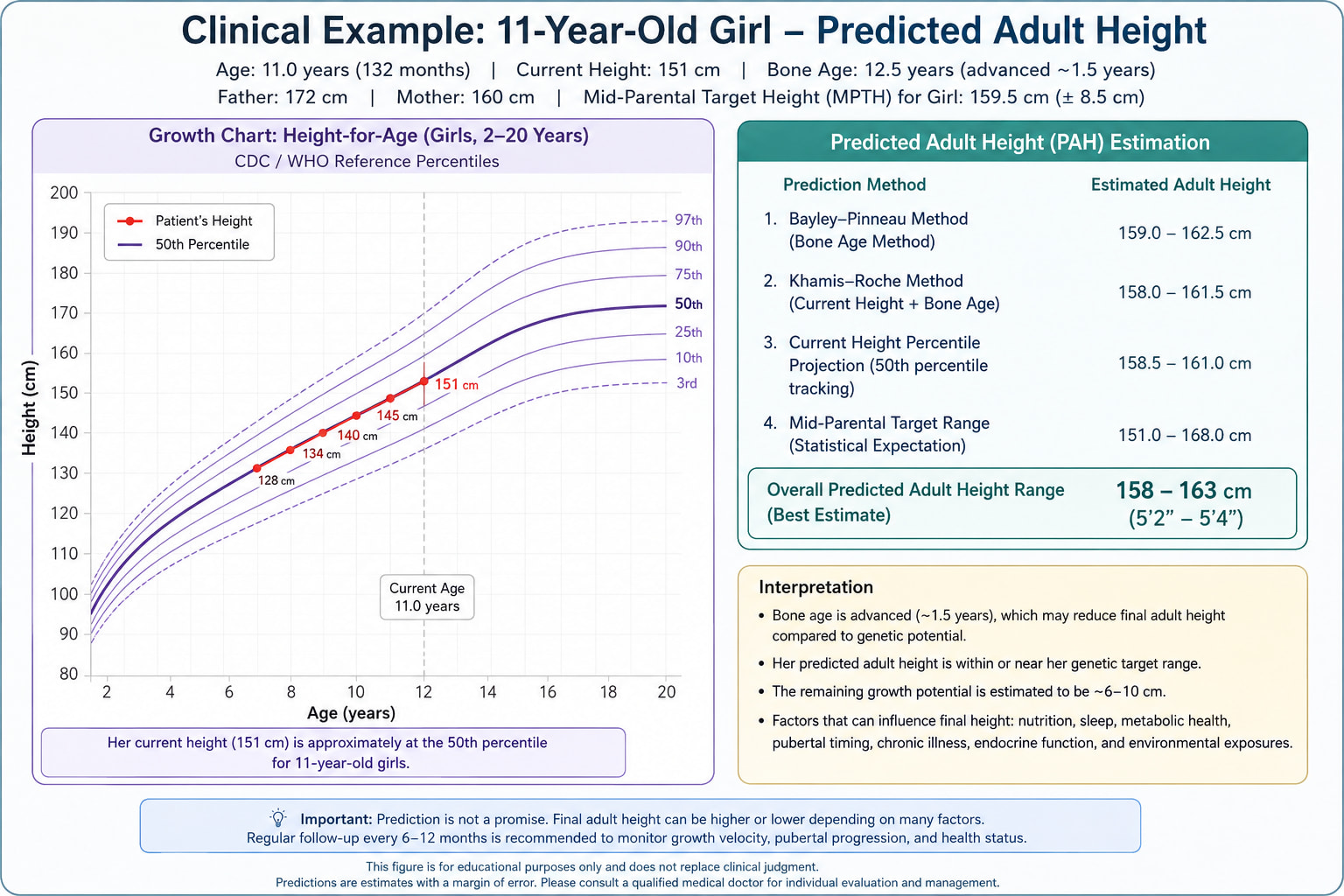
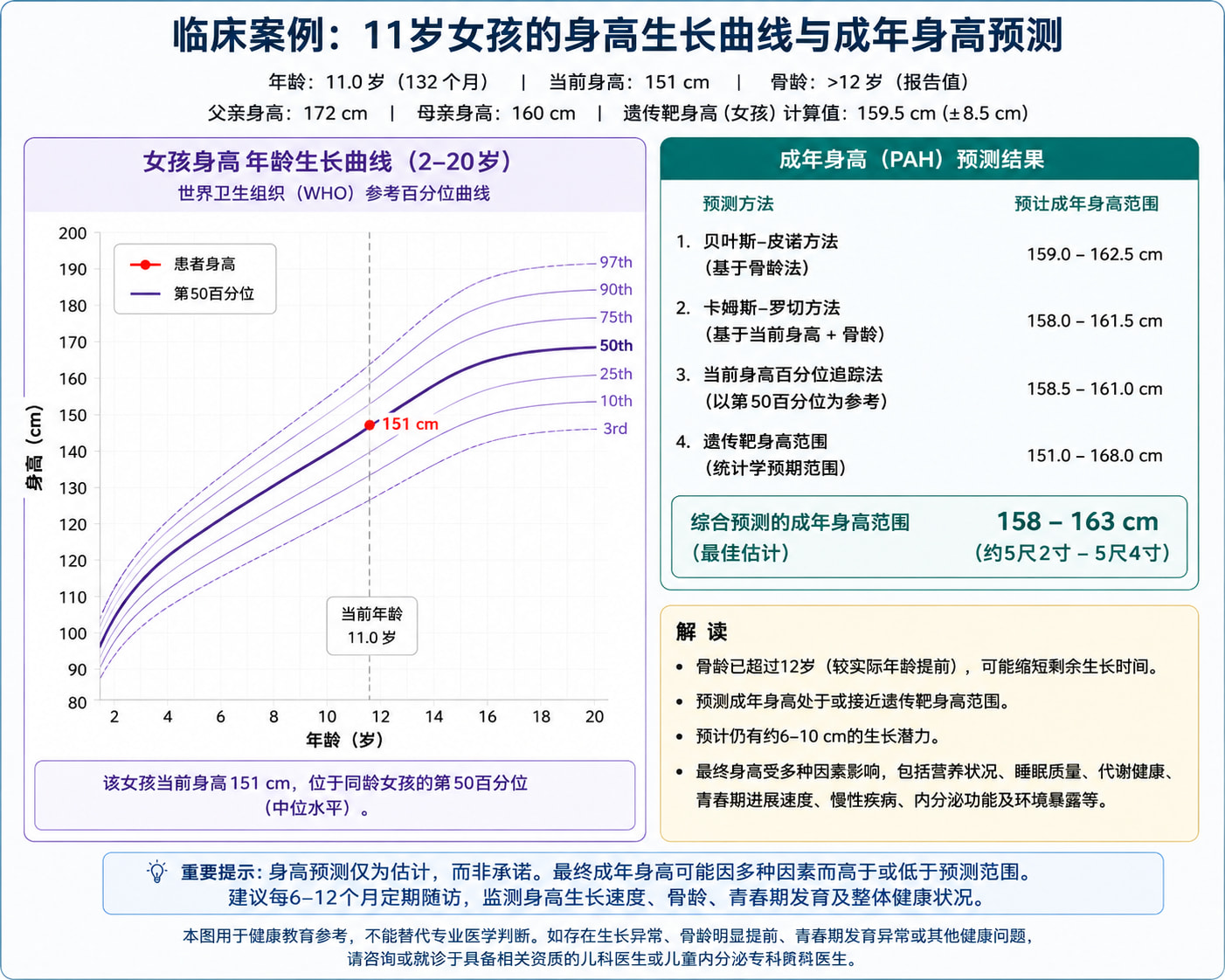
Figure 1. Estimated growth trajectory and predicted adult-height range in the illustrative 11-year-old girl. Current height is approximately 151 cm, parental heights are 172 cm and 160 cm, and reported bone age is greater than 12 years. Predictions remain approximate and depend on exact skeletal age, pubertal stage, growth velocity, and future health.
Nutrition Is Foundational
Normal linear growth requires much more than calcium. It requires adequate:
-
energy
-
high-quality protein
-
essential fatty acids
-
iron
-
zinc
-
magnesium
-
vitamin D
-
B vitamins
-
iodine
-
selenium
-
copper
-
phosphorus
Protein supports muscle, connective tissue, enzymes, hormones, immune proteins, and bone matrix. Micronutrients support ATP production, DNA synthesis, thyroid function, antioxidant defense, mitochondrial function, collagen synthesis, bone mineralization, and endocrine signaling.
The orthomolecular principle is:
Identify deficiency or insufficiency, restore physiologic adequacy, and avoid assuming that more is always better.
Correcting deficiency may support normal growth. It does not mean that supraphysiologic supplementation will make a nutritionally sufficient child taller.
Both Undernutrition and Overnutrition Matter
Poor nutrition can limit growth, but excessive or metabolically unhealthy nutrition can create a different problem.
A diet high in refined carbohydrates, sugary drinks, ultra-processed foods, and excess calories may contribute to:
-
obesity
-
hyperinsulinemia
-
insulin resistance
-
fatty liver
-
altered adrenal and sex-steroid physiology
-
advanced bone age in susceptible children
Some overweight children appear relatively tall early, yet accelerated childhood growth does not necessarily predict greater adult height.
Thus:
A child may grow faster early while consuming the remaining growth window more rapidly.
Height should therefore be interpreted together with weight, BMI, growth velocity, Tanner stage, and bone age.
Gut, Liver, Metabolism, and Growth
Children do not grow simply from what they eat. They grow from what they can:
digest → absorb → metabolize → use
Gastrointestinal disease can impair growth through poor nutrient absorption, chronic inflammation, poor appetite, and protein or micronutrient deficiency. Important examples include celiac disease, inflammatory bowel disease, chronic diarrhea, malabsorption, and selected infections.
A child with poor growth, anemia, abdominal symptoms, unexplained nutrient deficiency, weight loss, or poor weight gain may need gastrointestinal evaluation.
The liver is also part of the growth system. Much circulating IGF-1 is produced by the liver in response to growth-hormone signaling. Nutrition, inflammation, obesity, insulin resistance, fatty liver, and chronic liver disease can therefore influence GH–IGF-1 physiology.
The liver also helps metabolize estrogens, androgens, thyroid hormones, glucocorticoids, and other hormones.
This is why a growth problem may involve several connected systems:
gut → nutrient absorption → liver/metabolism → endocrine signaling → growth plate
Environmental Toxicants and Endocrine Disruption
Children may be especially vulnerable to environmental exposures because endocrine, neurological, reproductive, and skeletal systems are still developing.
Potential exposures include:
-
lead
-
mercury
-
arsenic
-
pesticides
-
bisphenols
-
phthalates
-
selected persistent organic pollutants
-
tobacco smoke
-
contaminated traditional medicines or supplements
-
occupational contaminants brought into the home
Some environmental chemicals may interfere with estrogen, androgen, thyroid, steroid, hypothalamic-pituitary, oxidative-stress, or mitochondrial pathways.
However:
A toxicant exposure should not automatically be assumed to explain advanced bone age or altered puberty in an individual child.
Exposure history and validated testing matter.
Ask about old housing, peeling paint, contaminated soil, large predatory fish, well water, pesticide exposure, secondhand smoke, imported remedies or supplements, industrial contamination, and family occupational exposures.
When a credible exposure exists, targeted testing may include:
-
blood lead
-
appropriate mercury testing
-
arsenic testing
-
other exposure-specific toxicology
Broad commercial toxin panels, hair testing interpreted as total-body toxicity, and provocative chelation testing should not routinely be used for pediatric height assessment.
Systems medicine should broaden clinical thinking without lowering evidentiary standards.
Sleep, Exercise, and Psychological Health
Growth-hormone secretion is closely related to sleep, particularly deep sleep. Yet many children experience late-night homework, excessive screen exposure, irregular schedules, chronic sleep restriction, and heavy academic pressure.
Sleep also influences insulin sensitivity, cortisol, appetite, immune regulation, mood, cognition, and metabolic health.
Before considering expensive growth interventions, ask:
Is the child consistently getting adequate restorative sleep?
Regular physical activity, outdoor activity, sports, and age-appropriate resistance exercise support general health and skeletal development. No specific exercise has been proven to override genetic height potential.
Height anxiety itself can also become harmful. Height management should remain part of health management, not become a competition.
A Practical I-OM Pediatric Height Workup
The following protocol provides a practical framework before pharmacologic growth intervention is considered. It is not a rigid one-size-fits-all testing package.
Step 1 — Confirm the Growth Phenotype
Document:
-
exact age
-
height, weight, BMI
-
height and weight percentiles
-
serial measurements
-
6–12 month growth velocity
-
parental heights and mid-parental target height
-
gestational history
-
birth weight and length
-
chronic illnesses and medications
Look for falling height percentiles, unusually slow or rapid growth, disproportion, or major discrepancy from familial target.
A single height measurement is not enough. The trajectory matters.
Step 2 — Assess Puberty and Bone Age
Document:
-
Tanner stage
-
breast development in girls
-
testicular development in boys
-
pubic/axillary hair
-
acne/body odor
-
menstrual history
-
timing and rate of pubertal progression
When clinically indicated, obtain a formal bone-age study and interpret it together with growth velocity, current height, Tanner stage, and parental target height.
Step 3 — Detailed Nutrition Assessment
Review:
-
total calorie and protein intake
-
dietary diversity
-
restrictive diets
-
vegetarian/vegan diet
-
ultra-processed foods
-
sugary drinks
-
calcium-rich foods
-
fish intake
-
supplement use
Look for protein-energy inadequacy, iron/zinc/vitamin D/B-vitamin risk, or excessive calorie intake.
Step 4 — Core Biochemical, Nutritional, and Metabolic Laboratory Panel
Testing should be individualized, but a reasonable initial panel may include:
Basic screening
-
CBC with differential
-
urinalysis
-
comprehensive metabolic panel
-
total protein, albumin
-
bilirubin
-
creatinine, BUN
-
electrolytes
Liver and metabolic health
-
ALT, AST, GGT, alkaline phosphatase
-
fasting glucose
-
fasting insulin when clinically useful
-
HbA1c
-
triglycerides
-
HDL-C, LDL-C, total cholesterol
Iron
-
ferritin
-
serum iron
-
TIBC or transferrin
-
transferrin saturation
Bone and mineral metabolism
-
total calcium
-
ionized calcium when indicated
-
phosphorus
-
magnesium
-
alkaline phosphatase
-
25-hydroxyvitamin D
-
PTH when calcium, phosphorus, vitamin D, or bone health is abnormal
Micronutrients when indicated
-
vitamin B12
-
folate
-
zinc
-
magnesium
-
copper
-
ceruloplasmin
-
selenium
-
iodine status where appropriate
Thyroid
-
TSH
-
free T4
-
TPO antibodies and thyroglobulin antibodies when autoimmune thyroid disease is suspected
Reverse T3 is not recommended as a routine pediatric growth test because its clinical value here is uncertain.
Inflammation / selected metabolic markers
-
hs-CRP or CRP
-
ESR
-
homocysteine when clinically relevant
Optional orthomolecular fatty-acid assessment
-
Omega-3 Index
-
EPA, DHA, DPA
-
arachidonic acid/EPA ratio
-
omega-6/omega-3 ratio
These are nutritional/metabolic markers, not direct predictors of height.
Routine height evaluation should not include adult cardiovascular tests such as CAC, CCTA, CIMT, PSA, D-dimer, or broad coagulation testing unless another medical indication exists.
Laboratory findings must be interpreted in the context of growth velocity, pubertal stage, bone age, diet, body composition, symptoms, and family history.
Step 5 — GH–IGF-1 and Thyroid Axis
Consider:
-
TSH
-
free T4
-
IGF-1
-
IGFBP-3
Interpret IGF-1 according to age, sex, pubertal stage, nutritional status, and liver function.
Do not diagnose GH deficiency from IGF-1 alone. Formal GH stimulation testing should generally be reserved for children whose growth pattern and initial evaluation raise genuine concern.
Step 6 — Pubertal and Adrenal Hormones
When bone age is advanced or puberty is atypical, consider:
Girls
-
LH
-
FSH
-
estradiol
Boys
-
LH
-
FSH
-
total testosterone
When adrenal androgens are relevant
-
DHEA-S
-
androstenedione
-
testosterone
-
17-hydroxyprogesterone
Dynamic GnRH or GnRH-agonist testing may be considered by a pediatric endocrinologist when indicated.
Step 7 — Gastrointestinal and Inflammatory Assessment
When indicated by symptoms or poor growth, consider:
-
tissue transglutaminase IgA
-
total IgA
-
CRP or hs-CRP
-
ESR
-
fecal calprotectin
Further GI or stool testing should be symptom-driven.
Step 8 — Environmental Exposure and Toxicology Assessment
Take a structured exposure history first. When a credible pathway exists, consider:
-
blood lead
-
mercury testing appropriate to the exposure
-
arsenic testing
-
other targeted toxicology
Avoid indiscriminate testing.
Step 9 — Sleep, Exercise, and Family Factors
Document:
-
bedtime and wake time
-
total sleep
-
screen exposure
-
snoring or possible sleep apnea
-
exercise and outdoor activity
-
sedentary time
-
academic stress
-
body-image concerns
-
restrictive eating
-
family pressure concerning height
Correct obvious sleep deprivation and unhealthy behavioral patterns.
Step 10 — Correct Upstream Abnormalities First
Before prescribing a growth-directed medication:
Iron deficiency → correct it
Protein insufficiency → improve dietary protein
Vitamin D deficiency → restore adequacy
Zinc deficiency → correct it
Celiac disease → treat it
Hypothyroidism → treat it
Sleep deprivation → restore sleep
Metabolic dysfunction → improve metabolic health
Fatty liver → address metabolic and hepatic health
Environmental toxicant exposure → reduce or eliminate exposure
Abnormal puberty → evaluate and treat the relevant endocrine axis
The first intervention should often be:
removal of the biological constraint rather than addition of a growth-promoting drug.
Step 11 — Reassess Growth
After correcting abnormalities, reassess:
-
height
-
weight/BMI
-
growth velocity
-
Tanner stage
-
pubertal progression
-
relevant nutritional/metabolic markers
Repeat bone age only when clinically appropriate and after enough time has elapsed.
Step 12 — Estimate Remaining Growth Potential
Before discussing medication, integrate:
-
current height
-
parental target height
-
growth velocity
-
bone age
-
Tanner stage
-
pubertal tempo
-
predicted adult height
-
underlying diagnosis
No prediction method can guarantee adult height. Predictions should be presented as a range with uncertainty.
When to Consult a Qualified Medical Doctor
Complex pediatric growth cases should be evaluated by a qualified medical doctor, ideally a pediatrician or pediatric endocrinologist experienced in growth and puberty.
Medical consultation is particularly important when there is:
-
markedly short stature
-
rapidly falling height percentile
-
unusually slow or rapid growth
-
substantially advanced or delayed bone age
-
early or rapidly progressing puberty
-
absent or delayed puberty
-
abnormal thyroid studies
-
abnormal IGF-1 or suspected GH deficiency
-
adrenal or gonadal hormone abnormalities
-
suspected pituitary disease
-
chronic gastrointestinal disease
-
liver dysfunction
-
chronic systemic illness
-
suspected toxicant exposure
-
neurological symptoms
-
consideration of hormone therapy
Hormonal treatment in children should be prescribed and monitored by an appropriately qualified physician after diagnosis, skeletal maturity, expected benefit, cost, and risk have been established.
Only at the End: Where Does Growth Hormone Fit?
Recombinant human growth hormone has legitimate pediatric indications, including proven GH deficiency and selected other defined growth disorders.
Before considering treatment, ask:
-
Is the child actually short?
-
Is growth velocity abnormal?
-
Is GH physiology abnormal?
-
Have nutritional and systemic causes been addressed?
-
How advanced is bone age?
-
How much growth potential remains?
-
What is the realistic expected adult-height benefit?
-
What are the cost, treatment burden, and monitoring requirements?
Growth hormone should therefore be viewed as:
specific treatment for selected growth phenotypes—not the automatic endpoint of parental concern about height.
What About hCG?
Human chorionic gonadotropin has a long history in reproductive and endocrine medicine, but its mechanism is fundamentally different from GH.
hCG acts through the LH receptor and stimulates endogenous gonadal steroid production. In selected males with hypogonadotropic hypogonadism, this may be therapeutically useful.
Potential advantages in the appropriate setting include long clinical experience, well-characterized pharmacology, endogenous gonadal stimulation, lower cost than prolonged GH therapy in many settings, and less frequent administration in some protocols.
But these advantages do not make hCG a general height-enhancement therapy.
In girls, ovarian stimulation may increase estrogenic signaling. Estrogen is essential for puberty but also contributes to skeletal maturation, advancement of bone age, and eventual growth-plate closure.
Therefore:
A treatment can increase short-term growth while simultaneously shortening the remaining growth window.
For a girl whose bone age is already advanced, this concern is particularly relevant.
There is currently insufficient evidence to recommend hCG as an alternative to GH for increasing final adult height in otherwise normally developing girls.
Returning to the 11-Year-Old Girl
For this illustrative child, the main issue is not obvious short stature.
The clinically useful questions are:
-
How fast has she grown over the previous year?
-
What is the exact bone age?
-
What is her Tanner stage?
-
Is puberty progressing normally or rapidly?
-
Is she nutritionally replete?
-
Is metabolic and liver health normal?
-
Is there evidence of celiac disease or chronic inflammation?
-
Is thyroid function normal?
-
Are adrenal and gonadal hormones appropriate for her developmental stage?
-
Is there a plausible environmental toxicant exposure?
-
Is sleep adequate?
-
What is her realistic remaining growth potential?
That is a stronger framework than choosing a hormone first and looking for justification afterward.
The I-OM and Orthomolecular Principle
The objective should not be:
“Find a hormone that makes the growth chart rise faster.”
It should be:
Create the physiological conditions in which the child can express healthy biological growth potential.
That means:
adequate nutrition → healthy digestion and absorption → good metabolic and liver health → appropriate endocrine signaling → adequate sleep and physical activity → reduction of avoidable environmental toxicant exposure → normal skeletal and pubertal development
If a true endocrine deficiency exists, treat it. If a nutrient deficiency exists, correct it. If intestinal disease exists, address it. If metabolic dysfunction exists, improve it. If a significant environmental exposure exists, reduce or eliminate it.
And if the child is healthy and growing normally:
normal variation in height should not be turned into a disease.
A Message to Parents
Parents naturally want the best for their children. But the best outcome is not necessarily the tallest possible child.
The better goal is a child who reaches biological potential with strong bones, healthy muscle, adequate nutrition, good metabolic health, normal endocrine development, healthy liver and gut function, good sleep, regular physical activity, psychological well-being, and minimal unnecessary medical intervention.
Before asking:
“How can we make our child taller?”
consider asking:
“Is there anything preventing our child from growing and developing as well as he or she naturally can?”
That question leads to better medicine.
Medical and Educational Disclaimer
This article is intended for medical education and general health information and does not provide individual diagnosis or treatment recommendations.
Children with abnormal growth, significantly advanced or delayed bone age, unusual pubertal development, suspected endocrine disease, chronic illness, nutritional deficiency, gastrointestinal disease, metabolic dysfunction, liver abnormalities, or suspected environmental toxicant exposure should be evaluated by a qualified medical doctor.
Complex cases should preferably be evaluated by a pediatrician, pediatric endocrinologist, or another appropriately qualified physician experienced in childhood growth and development.
Growth hormone, hCG, puberty-modifying therapy, or other hormonal treatments in children should only be considered after appropriate medical evaluation and should be prescribed and monitored by a qualified physician.