Chapter 1 — Basics of Health Chemistry
The Only Cause of Disease: Healing by Reversing Pathology — Thomas E. Levy, MD, JD
Part 1 of 3; physical source pages 27–32.
Book introduction and complete contents · Previous section · Next section · Next part
Editorial notice — separate from the source: This is a faithful reproduction of the author’s published source, not an I-OM clinical guideline or endorsement of every claim. It is educational material, not individualized medical advice. The source’s original disclaimers and copyright notices are retained. Safety note: Do not use this reproduction as instructions for self-treatment. Hydrogen peroxide mist can irritate the respiratory tract; higher exposures can cause serious lung injury. See CDC/ATSDR safety guidance.
Source page 27
Open original page 27 — full-size image

Section One The Biochemistry of Disease
27
Source page 28
Open original page 28 — full-size image

Source page 29
Open original page 29 — full-size image

Chapter 1 If everyone is thinking alike, then somebody isn’t thinking. George S Patton
Basics of Health Chemistry Redox Biology: The Chemistry of Life All health, sickness, and death events happen at the biomo- lecular level as energy flows or is impaired in its flow from one molecule to another through the exchange of electrons. This energy flow refers to the movement of electrons within cells, commonly known as reduction-oxidation (redox) biology. Reduction occurs when an oxidized molecule gains one or more electrons, thereby returning to its normal chemical state. Oxidation refers to the loss of electrons. Redox biology effectively describes biological health as it relates directly to the degree of oxidation (the loss of electrons) versus reduction (the restoration of electrons) in and among the biomolecules throughout the body. This has led directly to the frequent use of the concept of “oxidative stress” as the premier biomarker of all chronic diseases, which is now frequently discussed in the medical and scientific literature. 1 In other words, reduction and oxidation refer to the movement of electrons between mole- cules. When a normal biomolecule loses or gives up electrons, it becomes oxidized. When an oxidized biomolecule can regain the lost electrons, it becomes reduced and returns to its normal 29
Source page 30
Open original page 30 — full-size image

30 THE ONLY CAUSE OF DISEASE
biochemical state. 2 In a nutshell, oxidation is the opposite of reduction. Technically, the states of reduction and oxidation can also be viewed in terms of the status of hydrogen and oxygen. Reduction refers to the gain of hydrogen and the loss of oxygen, while oxida- tion refers to the loss of hydrogen and the gain of oxygen. However, it is simplest to think of redox biology in terms of electron movement and whether a given biomolecule is electron-depleted (oxidized) or electron-saturated (reduced).
Oxidation Always Impedes Biological Function All body tissues are composed of a wide array of biomole- cules, including sugars, fats, proteins, enzymes, structural mole- cules, DNA, and RNA. Additionally, all these biomolecules have specific functions in their interplay with one another, both inside and outside the cells. The essence of health depends on how well these molecules can chemically interact with one another. When there are no impediments to these interactions, biological function is optimized, and overall health in the body is also optimized. When any biomolecule is in an oxidized, electron-depleted state, it becomes either completely incapable of having its normal chemical interactions with other biomolecules (inactivation) or those interactions become severely impaired, as with an enzyme that is partially suppressed in its ability to participate in and accel- erate a chemical reaction. In such an oxidized state, that biomol- ecule is now officially “diseased.” When an oxidized biomolecule reacquires electron(s) so that it is brought back to the reduced, chemically stable state, it is no longer diseased and officially “normal” again. When excess oxidative stress is advanced, and a significant number of biomolecules are in the oxidized state, normal cellular metabolic function is further impaired or prevented. These non-functioning biomolecules not only lose their ability to function but also occupy space, which can effectively block or at least impede
Source page 31
Open original page 31 — full-size image
Basics of Health Chemistry 31
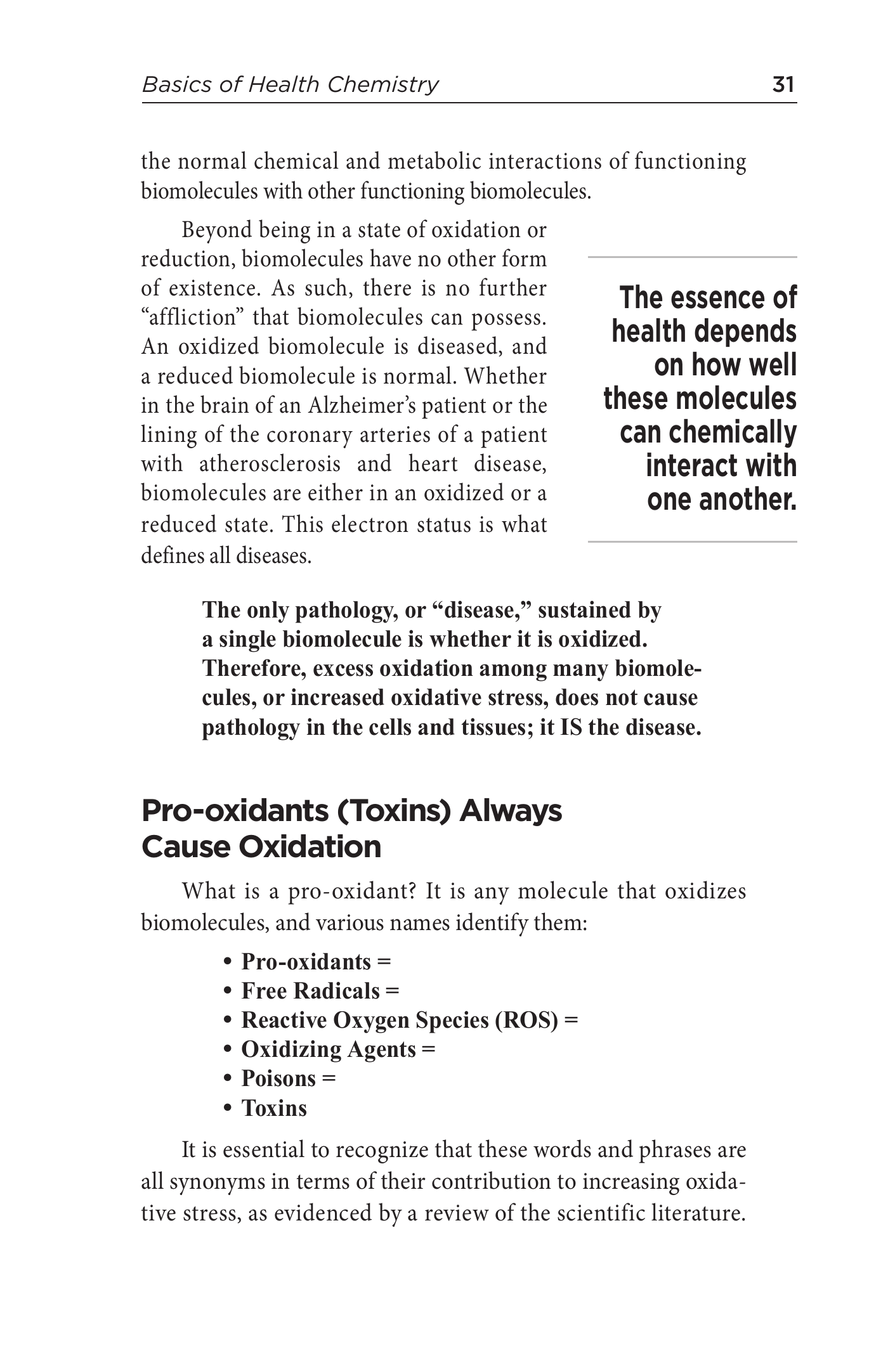
the normal chemical and metabolic interactions of functioning biomolecules with other functioning biomolecules. Beyond being in a state of oxidation or reduction, biomolecules have no other form of existence. As such, there is no further The essence of “affliction” that biomolecules can possess. An oxidized biomolecule is diseased, and health depends a reduced biomolecule is normal. Whether on how well in the brain of an Alzheimer’s patient or the these molecules lining of the coronary arteries of a patient can chemically with atherosclerosis and heart disease, interact with biomolecules are either in an oxidized or a one another. reduced state. This electron status is what defines all diseases.
The only pathology, or “disease,” sustained by a single biomolecule is whether it is oxidized. Therefore, excess oxidation among many biomole- cules, or increased oxidative stress, does not cause pathology in the cells and tissues; it IS the disease.
Pro-oxidants (Toxins) Always Cause Oxidation What is a pro-oxidant? It is any molecule that oxidizes biomolecules, and various names identify them: • Pro-oxidants = • Free Radicals = • Reactive Oxygen Species (ROS) = • Oxidizing Agents = • Poisons = • Toxins It is essential to recognize that these words and phrases are all synonyms in terms of their contribution to increasing oxida- tive stress, as evidenced by a review of the scientific literature.
Source page 32
Open original page 32 — full-size image

32 THE ONLY CAUSE OF DISEASE
They are all oxidizing agents, meaning they pull electrons away from normal, reduced biomolecules, while restoring electron balance to themselves, assuming a more stable biochemical state that never seeks to donate those Whether in the brain electrons back to another elec- of an Alzheimer’s tron-depleted molecule. patient or the lining On the other hand, antioxidants, of the coronary in the right microenvironment, donate electrons to electron-depleted arteries of a patient (oxidized) biomolecules. As such, with atherosclerosis antioxidants are grouped as reducing and heart disease, agents, restoring oxidized biomol- biomolecules are ecules to their healthy, biologically either in an oxidized or active state. Vitamin C (ascorbate), a reduced state. the most essential and widespread antioxidant in the body, is a prime example of redox biology and its impact on the body in both health and disease. In other words, pro-oxidants seek to remove electrons from biomolecules, oxidizing them and leaving them in an electron-de- pleted state until they can be repaired (reduced) by an antioxidant, such as vitamin C. A significant portion of contemporary scientific literature is devoted to examining and evaluating the effects of toxins on both acute and chronic diseases. This emphasis is certainly warranted, as the presence and biochemical impact of toxins is truly the etiology of ALL disease. However, one central point about toxins that is repeatedly overlooked or not fully appreci- ated is that all toxins are pro-oxidant. The terms “pro-oxidant” and “toxin” are often used interchangeably. To summarize and highlight these important˛points:
Book introduction and complete contents · Previous section · Next section · Next part