The I-OM Longevity Blueprint,
A Practical Framework for Modifiable Drivers of Healthy Aging
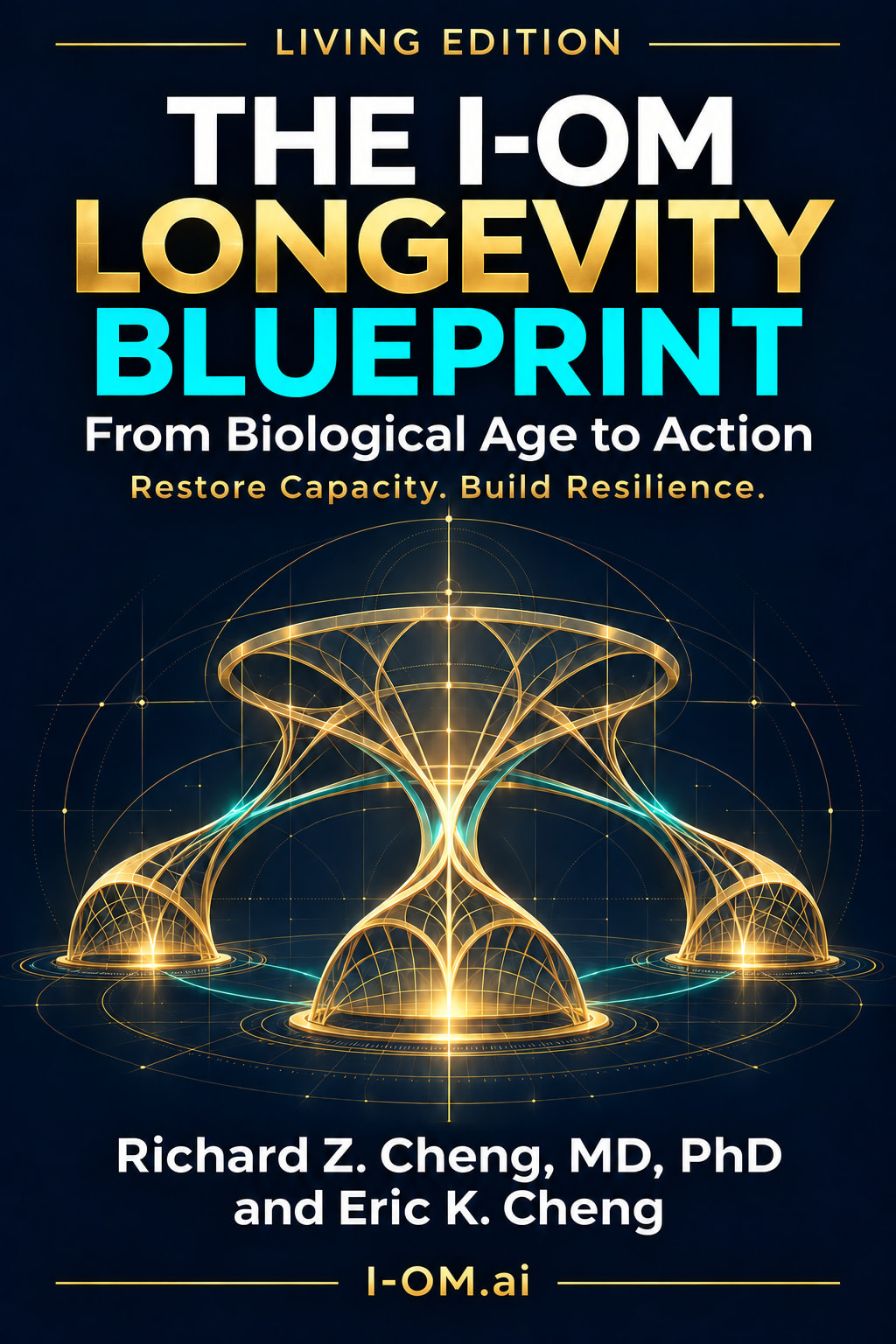
Richard Z. Cheng, M.D., Ph.D.
English-language book project
Current stage: editorial development
About this book
A biological-age report can prompt an important question: what should I do with this information?
From Biological Age to Action examines that question through an I-OM systems perspective. It connects measurement with the everyday concerns that make healthy aging meaningful: maintaining strength, mobility, independence, useful energy, and the ability to recover.
The book explores how metabolic health, nutrition, physical activity, sleep, stress, and other influences interact. Its organizing framework helps readers consider which functions deserve attention, what information could clarify the picture, and how progress might be reassessed over time.
Why read it?
Healthy-aging information often arrives in fragments: a laboratory result, a wearable score, a dietary recommendation, a supplement, or a headline about epigenetic clocks. Deciding how those pieces relate can be difficult.
This book offers a structured way to approach them. Readers are encouraged to connect measurements with practical goals, consider the strength and limits of evidence, and recognize when a question requires individualized clinical assessment.
The emphasis is on a sustainable decision process. A useful plan should account for function, safety, treatment burden, and quality of life alongside changes in test results.
The Three Capacities
The book uses three connected capacities as an I-OM conceptual framework.
Fuel Capacity
How the body handles, stores, mobilizes, and switches between metabolic fuels. This section introduces fuel flexibility and examines how metabolic measurements fit into a broader clinical picture.
Energy Capacity
How available fuel becomes useful cellular and whole-body work. The discussion connects mitochondrial biology with physical capacity, muscle, exercise tolerance, and physiological reserve.
Repair Capacity
How the body responds to stress, recovers, adapts, and maintains tissues. Sleep, recovery, nutritional adequacy, and inflammatory regulation are considered together.
These capacities organize the discussion. They are not independently validated diagnostic tests or scores.
What you will explore
- Biological age and biological function: how different measurements relate to the questions readers want answered
- Metabolism and nutrition: fuel flexibility, dietary quality, individualized carbohydrate tolerance, and preservation of muscle
- Energy and resilience: mitochondrial function, exercise capacity, inflammation, redox biology, and recovery
- Stress adaptation: fasting, exercise, sleep, circadian timing, and the balance between challenge and recovery
- Orthomolecular support: distinctions among nutritional adequacy, targeted supplementation, and pharmacologic-dose nutrient therapy
- Epigenetic plasticity: the relationship between inherited susceptibility, biological regulation, and modifiable influences
- Measurement over time: how to organize trends without treating every fluctuation as meaningful
- AI decision support: ways to structure information, identify missing context, and prepare questions for clinician review
What readers can take away
The book is designed to help readers:
- Relate healthy-aging goals to function and daily life
- Understand why a single score rarely answers every important question
- Organize measurements around a defined purpose
- Distinguish established findings from emerging evidence and hypotheses
- Recognize safety considerations and the need for individual context
- Use reassessment to decide whether a plan should continue, be simplified, or be reconsidered
Who it is for?
This book is intended for informed general readers interested in healthy aging, as well as clinicians and health educators seeking a systems-oriented discussion of function, reserve, and modifiable influences.
Readers encountering biological-age testing or wearable data may find the measurement chapters particularly relevant. Those interested in translating information into a manageable plan can turn to the implementation chapters after reviewing the foundational framework.
About the author
Richard Z. Cheng, M.D., Ph.D., is a physician-scientist whose work brings together metabolic health, orthomolecular medicine, healthy aging, systems thinking, and artificial intelligence. His clinical and educational interests include metabolic flexibility, nutritional adequacy, physical function, and longitudinal monitoring.
Table of Contents
Preface — Why Healthy Aging Needs an Action Framework
Part I — From Age to Action
- Why Aging Is Modifiable — Private review / coming soon
- From Chronological Age to Biological Function — Private review / coming soon
- Fuel Flexibility — Private review / coming soon
- Energy Capacity — Private review / coming soon
- Repair Capacity — Private review / coming soon
Part II — The Biological Drivers of Resilience
- The ICV Axis: Insulin, Cortisol, and Vitamin C — Private review / coming soon
- Inflammation, Oxidative Stress, and Mitochondrial Decline — Private review / coming soon
- Measure What Can Change — Private review / coming soon
Part III — Building Capacity
- Nutrition for Metabolic and Functional Longevity — Private review / coming soon
- Fasting, Exercise, and Hormetic Stress — Private review / coming soon
- Orthomolecular Support for Healthy Aging — Private review / coming soon
- Epigenetic Plasticity: From Genetic Susceptibility to Modifiable Biology — Private review / coming soon
- Stress, Sleep, Circadian Biology, and Recovery — Private review / coming soon
Part IV — From Information to Implementation
- AI as a Longevity Decision-Support Tool — Private review / coming soon
- A Practical Healthy-Aging Protocol — Private review / coming soon
- From Biological Age to Action — Private review / coming soon
Appendices
- Biomarker Reference Worksheet
- Healthy-Aging Self-Assessment
- Suggested Monitoring Cadence
- Evidence Classification Framework
- Glossary
- References
In Chapter 6, “ICV axis” names a conceptual I-OM framework connecting insulin, cortisol, and vitamin C. It does not denote a validated endocrine axis, diagnostic score, or proven combined treatment.
How to approach the book
Start with Chapters 1–5 to understand the Three Capacities and the book’s focus on function and reserve.
Read Chapters 6–8 for the biological connections and measurement questions that support the framework. Chapters 9–13 examine practical domains, including nutrition, physical challenges, nutrient support, and recovery.
Chapters 14–16 bring the discussion together through decision support and a repeatable process:
Measure → Interpret → Intervene → Reassess → Refine
The appendices are intended to help organize observations and questions. They do not establish universal testing requirements or treatment targets.
Evidence and limits
The manuscript distinguishes established evidence, emerging clinical evidence, mechanistic findings, clinical experience, and I-OM conceptual frameworks.
A plausible mechanism does not by itself establish a clinical benefit. A lower biological-age estimate or an improved biomarker should not be interpreted as proof of rejuvenation or longer human lifespan.
The book does not promise age reversal, guaranteed longevity, or a universal protocol. Decisions involving tests, supplements, fasting, exercise, medications, or other interventions depend on the individual and the relevant evidence.
Reading and availability
The English manuscript is undergoing editorial development. The project includes plans for Kindle, paperback, and an I-OM Living Edition.
Release dates, approved editions, reading links, access conditions, and any pricing will be announced once finalized. This page introduces the book project; it does not indicate that purchase or full-text access is currently available.
Medical information
This book is educational and does not provide individualized diagnosis or treatment. Decisions about treatment or changes to an existing care plan should be made with a qualified healthcare professional.