Rapid Virus Recovery — References and final source page

References and final source page

Rapid Virus Recovery — Thomas E. Levy, MD, JD

Part 1 of 9; physical source pages 268–273.

Book introduction and complete contents · Previous section · Next part

Editorial notice — separate from the source: This is a faithful reproduction of the author’s published source, not an I-OM clinical guideline or endorsement of every claim. It is educational material, not individualized medical advice. The source’s original disclaimers and copyright notices are retained. Safety note: Do not use this reproduction as instructions for self-treatment. Hydrogen peroxide mist can irritate the respiratory tract; higher exposures can cause serious lung injury. See CDC/ATSDR safety guidance.

Unchanged original PDF


Source page 268

Open original page 268 — full-size image

References Chapter One 1. Dockrell H, Playfair J (1983) Killing of blood-stage murine malaria parasites by hydrogen peroxide. Infection and Immunity 39:456- 459. PMID: 6822428 2. Heckert R, Best M, Jordan L et al., (1997) Efficacy of vaporized hydrogen peroxide against exotic animal viruses. Applied and Environmental Microbiology 63:3916-3918. PMID: 9327555 3. Berrie E, Andrews L, Yezli S, Otter J (2011) Hydrogen peroxide vapour (HPV) inactivation of adenovirus. Letters in Applied Microbiology 52:555-558. PMID: 21418259 4. Goyal S, Chander Y, Yezli S, Otter J (2014) Evaluating the virucidal efficacy of hydrogen peroxide vapour. The Journal of Hospital Infection 86:255-259. PMID: 24656442 5. Halliwell B, Clement M, Long L (2000) Hydrogen peroxide in the human body. FEBS Letters 486:10-13. PMID: 11108833 6. Caffarelli C, Calcinai E, Rinaldi L et al. (2012) Hydrogen peroxide in exhaled breath condensate in asthmatic children curing acute exacerbation and after treatment. Respiration 84:291-298. PMID: 23018317 7. Klebanoff S, Locksley R, Jong E, Rosen H (1983) Oxidative response of phagocytes to parasite invasion. Ciba Foundation Symposium 99:92-112. PMID: 6315321 8. Thomas D (2017) The phagocyte respiratory burst: historical perspectives and recent advances. Immunology Letters 192:88- 96. PMID: 28864335 9. Nagaraja C, Shashibhushan B, Sagar et al. (2012) Hydrogen peroxide in exhaled breath condensate: a clinical study. Lung India 29:123-127. PMID: 22628925 10. Rysz J, Stolarek R, Luczynski R et al. (2007) Increased hydrogen peroxide concentration in the exhaled breath condensate of stable COPD patients after nebulized N-acetylcysteine. Pulmonary Pharmacology & Therapeutics 20:281-289. PMID: 16753318 11. Reth M (2002) Hydrogen peroxide as second messenger in lymphocyte activation. Nature Immunology 3:1129-1134. PMID: 12447370 12. Nelson D, Murray D (1987) Dexamethasone inhibition of hydrogen peroxide-stimulated glucose transport. Endocrinology 120:156- 159. PMID: 3780558 13. Pillai K, Akhter J, Chua T, Morris D (2012) Mucolysis by ascorbic acid and hydrogen peroxide on compact mucin secreted in pseu- domyxoma peritonei. The Journal of Surgical Research 174:e69- e73. PMID: 22261589 14. Boveris A, Chance B (1973) The mitochondrial generation of hydrogen peroxide. General properties and effect of hyperbaric oxygen. The Biochemical Journal 134:707-716. PMID: 4749271 267

Source page 269

Open original page 269 — full-size image

268 RAPID VIRUS RECOVERY

15. Bao L, Avshalumov M, Patel J et al. (2009) Mitochondria are the source of hydrogen peroxide for dynamic brain-cell signaling. The Journal of Neuroscience 29:9002-9010. PMID: 19605638 16. Rice M (2011) H2O2: a dynamic modulator. Neuroscientist 17:389- 406. PMID: 21666063 17. Arnaiz S, Coronel M, Boveris A (1999) Nitric oxide, superoxide, and hydrogen peroxide production in brain mitochondria after halo- peridol treatment. Nitric Oxide: Biology and Chemistry 3:235-243. PMID: 10442855 18. Rowen R (2019) Ozone and oxidation therapies as a solution to the emerging crisis in infectious disease management: a review of current knowledge and experience. Medical Gas Research 9:232- 237. PMID: 31898609 19. Maddalena L, Selim S, Fonseca J et al. (2017) Hydrogen peroxide production is affected by oxygen levels in mammalian cell culture. Biochemical and Biophysical Research Communications 493:246- 251. PMID: 28899780 20. Munns S, Lui J, Arthur P (2005) Mitochondrial hydrogen peroxide production alters oxygen consumption in an oxygen-concen- tration-dependent manner. Free Radical Biology & Medicine 38:1594-1603. PMID: 15917188 21. Hidvegi M (2020) Inhaled nebulized sodium pyruvate use in COVID-19 patients. The Israel Medical Association Journal 22:278. PMID: 32378817 22. Jobsis Q, Raatgeep H, Schellekens S et al. (1998) Hydrogen peroxide in exhaled air of healthy children: reference values. The European Respiratory Journal 12:483-485. PMID: 9727806 23. Varma S, Devamanoharan P (1990) Excretion of hydrogen peroxide in human urine. Free Radical Research Communications 8:73-78. PMID: 2318421 24. Gough D, Cotter T (2011) Hydrogen peroxide: a Jekyll and Hyde signalling molecule. Cell Death & Disease 2:e213. PMID: 21975295 25. Lee J, Walker K, Han H (2019) Spontaneous generation of hydrogen peroxide from aqueous microdroplets. Proceedings of the National Academy of Sciences of the United States of America 116:19294-19298. PMID: 31451646 26. Zhu C, Francisco J (2020) Production of hydrogen peroxide enabled by microdroplets. Proceedings of the National Academy of Sciences of the United States of America 116:19222-19224. PMID: 31484759 27. Lazarou J, Pomeranz B, Corey P (1998) Incidence of adverse drug reactions in hospitalized patients: a meta-analysis of prospective studies. JAMA 279:1200-1205. PMID: 9555760 28. Watt B, Proudfoot A, Vale J (2004) Hydrogen peroxide poisoning. Toxicological Reviews 23:51-57. PMID: 15298493

Source page 270

Open original page 270 — full-size image

References 269

29. Akuji M, Chambers D (2017) Hydrogen peroxide: more harm than good? British Journal of Anaesthesia 118:958-959. PMID: 28575345

Chapter Two 1. Winterbourn C (1995) Toxicity of iron and hydrogen peroxide: the Fenton reaction. Toxicology Letters 82-83:969-974. PMID: 8597169 2. Aruoma O, Halliwell B (1988) The iron-binding and hydroxyl radical scavenging action of anti-inflammatory drugs. Xenobiotica 18:459- 470. PMID: 3135672 3. Halliwell B, Clement M, Ramalingham J, Long L (2000) Hydrogen peroxide. Ubiquitous in cell culture and in vivo? IUBMB Life 50: 251-257. PMID: 11327318 4. Root R, Metcalf J, Oshino N, Chance B (1975) H2O2 release from human granulocytes during phagocytosis. I. Documentation, quantitation, and some regulating factors. The Journal of Clinical Investigation 55:945-955. PMID: 1123431 5. Root R, Metcalf J (1977) H2O2 release from human granulocytes during phagocytosis. Relationship to superoxide anion forma- tion and cellular catabolism of H2O2: studies with normal and cytochalasin B-treated cells. The Journal of Clinical Investigation 60:1266-1279. PMID: 199619 6. Levine M, Padayatty S, Espey M (2011) Vitamin C: a concentra- tion-function approach yields pharmacology and therapeutic discoveries. Advances in Nutrition 2:78-88. PMID: 22332036 7. Pei Z, Wu K, Li Z et al. (2019) Pharmacologic ascorbate as a pro-drug for hydrogen peroxide release to kill mycobacteria. Biomedicine & Pharmacotherapy 109:2119-2127. PMID: 30551469 8. Fenton H (1894) Oxidation of tartaric acid in the presence of iron. J Chem Soc Trans 65:899-910. 9. Babuponnusami A, Muthukumar K (2014) A review on Fenton and improvements to the Fenton process for wastewater treatment. Journal of Environmental Chemical Engineering 2:557-572. 10. Valko M, Jomova K, Rhodes C et al. (2016) Redox- and non-re- dox-metal-induced formation of free radicals and their role in human disease. Archives of Toxicology 90:1-37. PMID: 26343967

Chapter Three 1. Martin A, Finlay W (2015) Nebulizers for drug delivery to the lungs. Expert Opinion on Drug Delivery 12:889-900. PMID: 25534396 2. Stein S, Thiel C (2017) The history of therapeutic aerosols: a chronological review. Journal of Aerosol Medicine and Pulmonary Drug Delivery 30:20-41. PMID: 27748638

Source page 271

Open original page 271 — full-size image

270 RAPID VIRUS RECOVERY

3. Muers M (1997) Overview of nebulizer treatment. Thorax 52 Suppl 2:S25-S30. PMID: 9155848 4. Aziz S, Scherliess, Steckel H (2020) Development of high dose oseltamivir phosphate dry powder for inhalation therapy in viral pneumonia. Pharmaceutics 12:1154. PMID: 33261071 5. Shirk M, Donahue K, Shirvani J (2006) Unlabeled uses of nebu- lized medications. American Journal of Health-System Pharmacy 63:1704-1716. PMID: 16960254 6. Martin A, Finlay W (2015) Nebulizers for drug delivery to the lungs. Expert Opinion on Drug Delivery 12:889-900. PMID: 25534396 7. Lavorini F, Buttini F, Usmani O (2019) 100 years of drug delivery to the lungs. Handbook of Experimental Pharmacology 260:143-159. PMID: 31792683 8. Fontana G, Lavorini F, Pistolesi M (2002) Water aerosols and cough. Pulmonary Pharmacology & Therapeutics 15:205-211. PMID: 12099765 9. Karimpour H, Hematpour B, Mohammadi S et al. (2020) Effect of nebulized eucalyptus for preventing ventilator-associated pneu- monia in patients under mechanical ventilation: a randomized double blind clinical trial. Alternative Therapies in Health and Medicine Feb 21. Online ahead of print. PMID: 32088670 10. McCarthy S, Gonzalez H, Higgins B (2020) Future trends in nebu- lized therapies for pulmonary disease. Journal of Personalized Medicine 10:E37. PMID: 32397615 11. Morais C, Nascimento J, Ribeiro A et al. (2020) Nebulization of vancomycin provides higher lung tissue concentrations than intra- venous administration in ventilated female piglets with healthy lungs. Anesthesiology 132:1516-1527. PMID: 32053565 12. Reifen R, Berkovich Z, Mandelberg A (2015) Vitamin A supplemen- tation via aerosol spray in asthmatic children. Pediatric Allergy and Immunology 26:578-579. PMID: 26173085 13. Gelfand C, Sakurai R, Wang Y et al. (2020) Inhaled vitamin A is more effective than intramuscular dosing in mitigating hyperox- ia-induced lung injury in a neonatal rat model of bronchopulmo- nary dysplasia. American Journal of Physiology. Lung Cellular and Molecular Physiology 319:L576-L584. PMID: 32755324 14. Taylor S, Sakurai R, Sakurai T, Rehan V (2016) Inhaled vitamin D: a novel strategy to enhance neonatal lung maturation. Lung 194:931-943. PMID: 27614961 15. Kalmarzi R, Ahmadi S, Rahehagh R et al. (2020) The effect of vitamin D supplementation on clinical outcomes of asthmatic children with vitamin D insufficiency. Endocrine, Metabolic & Immune Disorders Drug Targets 20:149-155. PMID: 31942850

Source page 272

Open original page 272 — full-size image
References 271

16. Yamamoto Y, Enkhbaatar P, Sousse L et al. (2012) Nebulization with ɣ-tocopherol ameliorates acute lung injury after burn and smoke inhalation in the ovine model. Shock 37:408-414. PMID: 22266978 17. Laouini A, Andrieu V, Vecellio L et al. (2014) Characterization of different vitamin E carriers intended for pulmonary drug delivery. International Journal of Pharmaceutics 471:385-390. PMID: 24939617 18. Levin E, Behm F, Carnahan E et al. (1993) Clinical trials using ascorbic acid aerosol to aid smoking cessation. Drug and Alcohol Dependence 33:211-223. PMID: 8261886 19. Antolick A, Ouellette L, Judge B et al. (2020) Accidental chlorine gas exposure in a pediatric patient: a case report. Clinical Practice and Cases in Emergency Medicine 4:205-207. PMID: 32426673 20. Bosse G (1994) Nebulized sodium bicarbonate in the treatment of chlorine gas inhalation. Journal of Toxicology. Clinical Toxicology 32:233-241. PMID: 8007031 21. Vinsel P (1990) Treatment of acute chlorine gas inhalation with nebulized sodium bicarbonate. The Journal of Emergency Medicine 8:327-329. PMID: 2165079 22. Ahmed T, Iskandrani A, Uddin M (2000) Sodium bicarbonate solution nebulization in the treatment of acute severe asthma. American Journal of Therapeutics 7:325-327. PMID: 11317181 23. Devadason S (2006) Recent advances in aerosol therapy for children with asthma. Journal of Aerosol Medicine 19:61-66. PMID: 16551216 24. Murphy K, Hong J, Wandalsen G et al. (2020) Nebulized inhaled corticosteroids in asthma treatment in children 5 years or younger: a systematic review and global expert analysis. The Journal of Allergy and Clinical Immunology. In Practice Jan 30. Online ahead of print. PMID: 32006721 25. Rossi I, Sonvico F, McConville J et al. (2018) Nebulized coenzyme Q10 nanosuspensions: a versatile approach for pulmonary anti- oxidant therapy. European Journal of Pharmaceutical Sciences 113:159-170. PMID: 29066385 26. Adewale A, Libby E, Fu L et al. (2020) Novel therapy of bicar- bonate, glutathione, and ascorbic acid improves cystic fibrosis mucus transport. American Journal of Respiratory Cell and Molecular Biology 63:362-373. PMID: 32374624 27. Wu L, Yu Y, Li L et al. (2020) [Clinical effect of nebulized acetyl- cysteine inhalation combined with bronchoscopy in the treatment of elderly patients with severe ventilator-associated pneumonia]. Article in Chinese. 36:267-272. PMID: 32340416 28. Fox L, Foushee J, Jackson D, Watson H (2011) Visual compati- bility of common nebulizer medications with 7% sodium chloride solution. American Journal of Health-System Pharmacy 68:1032- 1035. PMID: 21593232

Source page 273

Open original page 273 — full-size image

272 RAPID VIRUS RECOVERY

29. Zhong L, Xiong Y, Zheng Z et al. (2020) Effect of short-term inha- lation of warm saline atomised gas on patients with non-cystic fibrosis bronchiectasis. ERJ Open Research 6:00130-2019. PMID: 32055629 30. Cho J, Kim H, Yang H et al. (2020) Pilot study of aerosolized plus intravenous vancomycin in mechanically ventilated patients with methicillin-resistant Staphylococcus aureus pneumonia. Journal of Clinical Medicine 9:476. PMID: 32050447 31. Akkerman-Nijland A, Yousofi M, Rottier B et al. (2020) Eradication of Pseudomonas aeruginosa in cystic fibrosis patients with inhalation of dry powder tobramycin. Therapeutic Advances in Respiratory Disease 14:1753466620905279. PMID: 32046620 32. Prazak J, Valente L, Iten M et al. (2020) Nebulized bacteriophages for prophylaxis of experimental ventilator-associated pneumonia due to methicillin-resistant Staphylococcus aureus. Critical Care Medicine Apr 16. Online ahead of print. PMID: 32304419 33. Chen L, Shi M, Deng Q et al. (2020) A multi-center random- ized prospective study on the treatment of infact bronchiolitis with interferon α1b nebulization. PLoS One 15:e0228391. PMID: 32084142 34. Brodski N (2020) Add-on or alone? Inhaled nebulized immunoglob- ulin reduces upper airway infections: 24 months of real-life experi- ence. Immunotherapy 12:389-394. PMID: 32308072 35. Kamel A, Amin O (2020) Analgo-sedative effects of oral or nebu- lized ketamine in preschoolers undergoing elective surgery: a comparative, randomized, double-blind study. Pain Physician 23:E195-E202. PMID: 32214298 36. Nguyen A, Denault A, Theoret Y et al. (2020) Inhaled milrinone in cardiac surgical patients: a pilot randomized controlled trial of jet vs. mesh nebulization. Scientific Reports 10:2069. PMID: 32034202 37. Klimke A, Hefner G, Will B, Voss U (2020) Hydroxychloroquine as an aerosol might markedly reduce and even prevent severe clinical symptoms after SARS-CoV-2 infection. Medical Hypotheses 142:109783. PMID: 32402766 38. Wan G, Tsai Y, Wu Y, Tsao K (2004) A large-volume nebulizer would not be an infectious source for severe acute respiratory syndrome. Infection Control and Hospital Epidemiology 25:1113- 1115. PMID: 15636302 39. Amirav I, Newhouse M (2020) Transmission of coronavirus by nebulizer: a serious, underappreciated risk. CMAJ 192:E346. PMID: 32392488 40. Benge C, Barwise J (2020) Aerosolization of COVID-19 and contamination risks during respiratory treatments. Federal Practitioner 37:160-163. PMID: 32322146 41. Choi K (2012) Viral polymerases. Advances in Experimental Medicine and Biology 726:267-304. PMID: 22297518


Book introduction and complete contents · Previous section · Next part

References and final source page

Rapid Virus Recovery — Thomas E. Levy, MD, JD

Part 2 of 9; physical source pages 274–279.

Book introduction and complete contents · Previous section · Previous part · Next part

Unchanged original PDF


Source page 274

Open original page 274 — full-size image

References 273

42. Yin W, Mao C, Luan X et al. (2020) Structural basis for inhibition of the RNA-dependent RNA polymerase from SARS-CoV-2 by remdesivir. Science 368:1499-1504. PMID: 32358203 43. Kaushik N, Subramani C, Anang S et al. (2017) Zinc salts block hepatitis E virus replication by inhibiting the activity of viral RNA-dependent RNA polymerase. Journal of Virology 91:e00754- 17. PMID: 28814517 44. Bohlmann L, De Oliveira D, El-Deeb I et al. (2018) Chemical synergy between ionophore PBT2 and zinc reverses antibiotic resistance. mBio 9:e02391-18. PMID: 30538186 45. Justiniano R, Perer J, Hua A et al. (2017) A topical zinc ionophore blocks tumorigenic progression in UV-exposed SKH-1 high-risk mouse skin. Photochemistry and Photobiology 93:1472-1482. PMID: 28503778 46. Vaden R, Guillen K, Salvant J et al. (2019) A cancer-selective zinc ionophore inspired by the natural product naamidine A. ACS Chemical Biology 14:106-117. PMID: 30571086 47. Xue J, Moyer A, Peng B et al. (2014) Chloroquine is a zinc ionophore. PLoS One 9:e109180. PMID: 25271834 48. Carlucci P, Ahuja T, Petrilli C et al. (2020) Zinc sulfate in combina- tion with a zinc ionophore may improve outcomes in hospitalized COVID-19 patients. Journal of Medical Microbiology 69:1228- 1234. PMID: 32930657 49. Dabbagh-Bazarbachi H, Clergeaud G, Quesada I et al. (2014) Zinc ionophore activity of quercetin and epigallocatechin-gallate: from Hepa 1-6 cells to a liposome model. Journal of Agricultural and Food Chemistry 62:8085-8093. PMID: 25050823 50. Levy T (2002) Curing the Incurable: Vitamin C, Infectious Diseases, and Toxins. Henderson, NV: MedFox Publishing 51. Levy T (2011) Primal Panacea. Henderson, NV: MedFox Publishing 52. Gonzales M, Berdiel M, Duconge J et al. (2018) High dose intra- venous vitamin C and influenza: a case report. Journal of Orthomolecular Medicine Volume 33 pp. 1-3. 53. Gonzales M, Berdiel M, Miranda-Massari J et al. (2016) High dose intravenous vitamin C treatment for Zika fever. Journal of Orthomolecular Medicine Volume 31, pp. 19-23. 54. Gonzales M, Miranda-Massari J, Berdiel M et al. (2014) High dose intravenous vitamin C and Chikungunya fever: a case report. Journal of Orthomolecular Medicine 29:154-156. PMID: 25705076 55. Rowen R, Robins H, Carew K et al. (2016) Rapid resolution of hemorrhagic fever (Ebola) in Sierra Leone with ozone therapy. African Journal of Infectious Diseases 10:49-54. 56. Al-Ani F, Chehade S, Lazo-Langner A (2020) Thrombosis risk associated with COVID-19 infection. A scoping review. Thrombosis Research 192:152-160. PMID: 32485418

Source page 275

Open original page 275 — full-size image

274 RAPID VIRUS RECOVERY

57. Al-Samkari H, Leaf R, Dzik W et al. (2020) COVID-19 and coagu- lation: bleeding and thrombotic manifestations of SARS-CoV-2 infection. Blood 136:489-500. PMID: 32492712 58. Colmenero I, Santonja C, Alonso-Riano M et al. (2020) SARS- CoV-2 endothelial infection causes COVID-19 chilblains: histo- pathological, immunohistochemical and ultrastructural study of seven paediatric cases. The British Journal of Dermatology 183:729-737. PMID: 32562567 59. Connors J, Levy J (2020) COVID-19 and its implications for thrombosis and anticoagulation. Blood 135:2033-2040. PMID: 32339221 60. Levy T (2019) Magnesium: Reversing Disease Henderson, NV: MedFox Publishing

Chapter 4 1. Del Pozo J (2018) Biofilm-related disease. Expert Review of Anti- Infective Therapy 16:51-65. PMID: 29235402 2. Kuang X, Chen V, Xu X (2018) Novel approaches to the control of oral microbial biofilms. BioMed Research International 2018:6498932. PMID: 30687755 3. Roy R, Tiwari M, Donelli G, Tiwari V (2018) Strategies for combating bacterial biofilms: a focus on anti-biofilm agents and their mechanisms of action. Virulence 9:522-554. PMID: 28362216 4. Mirzaei R, Mohammadzadeh R, Alikhani M et al. (2020) The biofilm-associated bacterial infections unrelated to indwelling devices. IUBMB Life 72:1271-1285. PMID: 32150327 5. Sato Y, Motoyama S, Takano H et al. (2016) Esophageal cancer patients have a high incidence of severe periodontitis and preop- erative dental care reduces the likelihood of severe pneumonia after esophagectomy. Digestive Surgery 33:495-502. PMID: 27287475 6. Surlin P, Mirela-Nicolae F, Marin-Surlin V et al. (2020) Could peri- odontal disease through periopathogen Fusobacterium nucleatum be an aggravating factor for gastric cancer? Journal of Clinical Medicine 9:E3885. PMID: 33260439 7. Castellarin M, Warren R, Freeman J et al. (2012) Fusobacterium nucleatum infection is prevalent in human colorectal carcinoma. Genome Research 22:299-306. PMID: 22009989 8. Kim M, Lee S, Choi S et al. (2020) Fusobacterium nucleatum in biopsied tissues from colorectal cancer patients and alcohol consumption in Korea. Scientific Reports 10:19915. PMID: 33199749 9. Vacante M, Ciuni R, Basile F, Biondi A (2020) Gut microbiota and colorectal cancer development: a closer look to the adenoma-car- cinoma sequence. Biomedicines 8:489. PMID: 33182693

Source page 276

Open original page 276 — full-size image

References 275

10. Karpinski T (2019) The microbiota and pancreatic cancer. Gastroenterology Clinics of North America 48:447-464. PMID: 31383281 11. Zeng X, Xia L, Zhang Y et al. (2016) Periodontal disease and incident lung cancer risk: a meta-analysis of cohort studies. Journal of Periodontology 87:1158-1164. PMID: 27294431 12. Liu Y, Yuan X, Chen K et al. (2020) Clinical significance and prog- nostic value of Porphyromonas gingivalis infection in lung cancer. Translational Oncology 14:100972 13. Tezal M, Sullivan M, Reid M et al. (2007) Chronic periodontitis and the risk of tongue cancer. Archives of Otolaryngology—Head & Neck Surgery 133:450-454. PMID: 17515503 14. Mattila K, Pussinen P, Paju S (2005) Dental infections and cardio- vascular diseases: a review. Journal of Periodontology 76:2085- 2088. PMID: 16277580 15. Ott S, El Mokhtari N, Musfeldt M et al. (2006) Detection of diverse bacterial signatures in atherosclerotic lesions of patients with coronary heart disease. Circulation 113:929-937. PMID: 16490835 16. Zaremba M, Gorska R, Suwalski P, Kowalski J (2007) Evaluation of the incidence of periodontitis-associated bacteria in the atherosclerotic plaque of coronary blood vessels. Journal of Periodontology 78:322-327. PMID: 17274722 17. Mahendra J, Mahendra L, Kurian V et al. (2010) 16S rRNA-based detection of oral pathogens in coronary atherosclerotic plaque. Indian Journal of Dental Research 21:248-252. PMID: 20657096 18. Haraszthy V, Zambon J, Trevisan M et al. (2000) Identification of periodontal pathogens in atheromatous plaques. Journal of Periodontology 71:1554-1560. PMID: 11063387 19. Pessi T, Karhunen V, Karjalainen P et al. (2013) Bacterial signa- tures in thrombus aspirates of patients with myocardial infarction. Circulation 127:1219-1228. PMID: 23418311 20. Pinon-Estaban P, Nunez L, Moure R et al. (2020) Presence of bacterial DNA in thrombotic material of patients with myocardial infarction. Scientific Reports 10:16299. PMID: 33004892 21. Vakhitov D, Tuomisto S, Martiskainen M et al. (2018) Bacterial signatures in thrombus aspirates of patients with lower limb arterial and venous thrombosis. Journal of Vascular Surgery 67:1902-1907. PMID: 28847664 22. Louhelainen A, Aho J, Tuomisto S et al. (2014) Oral bacterial DNA findings in pericardial fluid. Journal of Oral Microbiology 6:25835. PMID: 25412607 23. Pyysalo M, Pyysalo L, Pessi T et al. (2016) Bacterial DNA findings in ruptured and unruptured intracranial aneurysms. Acta Odontologica Scandinavica 74:315-320. PMID: 26777430

Source page 277

Open original page 277 — full-size image

276 RAPID VIRUS RECOVERY

24. Haheim L, Schwarze P, Thelle D et al. (2020) Low levels of anti- bodies for the oral bacterium Tannerella forsythia predict cardio- vascular disease mortality in men with myocardial infarction: a prospective cohort study. Medical Hypotheses 138:109575. PMID: 32088522 25. Dominy S, Lynch C, Ermini F et al. (2019) Porphyromonas gingivalis in Alzheimer’s disease brains: evidence for disease causation and treatment with small-molecule inhibitors. Science Advances 5:easu3333. PMID: 30746447 26. Diaz-Zuniga J, More J, Melgar-Rodriguez S et al. (2020) Alzheimer’s disease-like pathology triggered by Porphyromonas gingivalis in wild type rats is serotype dependent. Frontiers in Immunology 11:588036. PMID: 33240277 27. Dioguardi M, Crincoli V, Laino L et al. (2020) The role of peri- odontitis and periodontal bacteria in the onset and progression of Alzheimer’s disease: a systematic review. Journal of Clinical Medicine 9:495. PMID: 32054121 28. Ogrendik M (2013) Rheumatoid arthritis is an autoimmune disease caused by periodontal pathogens. International Journal of General Medicine 6:383-386. PMID: 23737674 29. Reichert S, Haffner M, Keysser G et al. (2013) Detection of oral bacterial DNA in synovial fluid. Journal of Clinical Periodontology 40:591-598. PMID: 23534379 30. Totaro M, Cattani P, Ria F et al. (2013) Porphyromonas gingivalis and the pathogenesis of rheumatoid arthritis: analysis of various compartments including the synovial tissue. Arthritis Research & Therapy 15:R66. PMID: 23777892 31. Flak M, Colas R, Munoz-Atienza E et al. (2019) Inflammatory arthritis disrupts gut resolution mechanisms, promoting barrier breakdown by Porphyromonas gingivalis. JCI Insight 4:e125191. PMID: 31292292 32. Du Q, Ma X (2020) [Research progress of correlation between peri- odontal pathogens and systemic diseases]. Article in Chinese. Journal of Southern Medical University 40:759-764. PMID: 32897213 33. Ye C, Katagiri S, Miyasaka N et al. (2020) The periodontopathic bacteria in placenta, saliva and subgingival plaque of threatened preterm labor and preterm low birth weight cases: a longitudinal study in Japanese pregnant women. Clinical Oral Investigations 24:4261-4270. PMID: 32333174 34. Fiorillo L, Cervino G, Laino L et al. (2019) Porphyromonas gingi- valis, periodontal and systemic implications: a systematic review. Dentistry Journal 7:114. PMID: 31835888 35. Zhou Y, Luo G (2019) Porphyromonas gingivalis and digestive system cancers. World Journal of Clinical Cases 7:819-829. PMID: 31024953

Source page 278

Open original page 278 — full-size image

References 277

36. Mei F, Xie M, Huang X et al. (2020) Porphyromonas gingivalis and its systemic impact: current status. Pathogens 9:944. PMID: 33202751 37. Laugisch O, Johnen A, Maldonado A et al. (2018) Periodontal pathogens and associated intrathecal antibodies in early stages of Alzheimer’s disease. Journal of Alzheimer’s Disease 66:105-114. PMID: 3022339 38. Adams B, Nunes J, Page M et al. (2019) Parkinson’s disease: a systemic inflammatory disease accompanied by bacterial inflam- magens. Frontiers in Aging Neuroscience 11:210. PMID: 31507404 39. Figueredo C, Sete M, Carlos J et al. (2018) Presence of anti-Por- phyromonas gingivalis-peptidylarginine deiminase antibodies in serum from juvenile systemic lupus erythematosus patients. Acta Reumatologica Portuguesa 43:239-240. PMID: 30414375 40. Bagavant H, Dunkleberger M, Wolska N et al. (2019) Antibodies to periodontogenic bacteria are associated with higher disease activity in lupus patients. Clinical and Experimental Rheumatology 37:106-111. PMID: 29998833 41. Hieken T, Chen J, Hoskin T et al. (2016) The microbiome of asep- tically collected human breast tissue in benign and malignant disease. Scientific Reports 6:30751. PMID: 27485780 42. Park D, Woo B, Lee B et al. (2019) Serum levels of interleukin-6 and titers of antibodies against Porphyromonas gingivalis could be potential biomarkers for the diagnosis of oral squamous cell carci- noma. International Journal of Molecular Sciences 20:2749. PMID: 31167516 43. Fischer L, Demerath E, Bittner-Eddy P, Costalonga M (2019) Placental colonization with periodontal pathogens: the poten- tial missing link. American Journal of Obstetrics and Gynecology 221:383-392. PMID: 31051120 44. Pillai R, Iyer K, Spin-Neto R et al. (2018) Oral health and brain injury: causal or casual relation? Cerebrovascular Diseases Extra 8:1-15. PMID: 29402871 45. Aoki S, Hosomi N, Nishi H et al. (2020) Serum IgG titers to peri- odontal pathogens predict 3-month outcome in ischemic stroke patients. PLoS One 15:e0237185. PMID: 32760103 46. Kudo C, Shin W, Sasaki N et al. (2018) Effects of periodontal treatment on carotid intima-media thickness in patients with life- style-related diseases: Japanese prospective multicentre obser- vational study. Odontology 106:316-327. PMID: 29330707 47. Giles J, Reinholdt J, Andrade F, Konig M (2020) Associations of antibodies targeting periodontal pathogens with subclinical coronary, carotid, and peripheral arterial atherosclerosis in rheu- matoid arthritis. Arthritis & Rheumatology Nov 17. Online ahead of print. PMID: 33205531

Source page 279

Open original page 279 — full-size image

278 RAPID VIRUS RECOVERY

48. Bracci P (2017) Oral health and the oral microbiome in pancreatic cancer: an overview of epidemiological studies. Cancer Journal 23:310-314. PMID: 29189325 49. Aoyama N, Kure K, Minabe M, Izumi Y (2019) Increased heart failure prevalence in patients with a high antibody level against periodontal pathogen. International Heart Journal 60:1142-1146. PMID: 31447467 50. Takamisawa K, Sugita N, Komatsu S et al. (2020) Association between serum IgG antibody titers against Porphyromonas gingi- valis and liver enzyme levels: a cross-sectional study in Sado Island. Heliyon 6:e05531. PMID: 33294679 51. Nakamori M, Hosomi N, Nishi H et al. (2020) Serum IgG titers against periodontal pathogens are associated with cerebral hemorrhage grow th and 3 -month outcome. PLoS One 15:e0241205. PMID: 33112888 52. Tuominen H, Taina M, Puranen M et al. (2020) Serum high-sensi- tive C-reactive protein may reflect periodontitis in patients with stroke. In Vivo 34:2829-2835. PMID: 32871821 53. Zhang Y, Leveille S, Edward J (2020) Wisdom teeth, periodontal disease, and C-reactive protein in US adults. Public Health 187:97-102. PMID: 32942171

Chapter 5 1. Donlan R and Costerton J (2002) Biofilms: survival mechanisms of clinically relevant microorganisms. Clinical Microbiology Reviews 15:167-193. PMID: 11932229 2. Roy R, Tiwari M, Donelli G, Tiwari V (2018) Strategies for combating bacterial biofilms: a focus on anti-biofilm agents and their mechanisms of action. Virulence 9:522-554. PMID: 28362216 3. Das T, Sehar S, Manefield M (2013) The roles of extracellular DNA in the structural integrity of extracellular polymeric substance and bacterial biofilm development. Environmental Microbiology Reports 5:778-786. PMID: 24249286 4. Chiba A, Sugimoto S, Sato F et al. (2015) A refined technique for extraction of extracellular matrices from bacterial biofilms and its applicability. Microbial Biotechnology 8:392-403. PMID: 25154775 5. Gilbert P, Das J, Foley I (1997) Biofilm susceptibility to antimicro- bials. Advances in Dental Research 11:160-167. PMID: 9524452 6. Hall-Stoodley L, Costerton J, Stoodley P (2004) Bacterial biofilms: from the natural environment to infectious diseases. Nature Reviews. Microbiology 2:95-108. PMID: 15040259 7. Parsek M, Singh P (2003) Bacterial biofilms: an emerging link to disease pathogenesis. Annual Review of Microbiology 57:677-701. PMID: 14527295 8. Fanning S, Mitchell A (2012) Fungal biofilms. PLoS Pathogens 8:e1002585. PMID: 22496639


Book introduction and complete contents · Previous section · Previous part · Next part
References and final source page

Rapid Virus Recovery — Thomas E. Levy, MD, JD

Part 3 of 9; physical source pages 280–285.

Book introduction and complete contents · Previous section · Previous part · Next part

Unchanged original PDF


Source page 280

Open original page 280 — full-size image

References 279

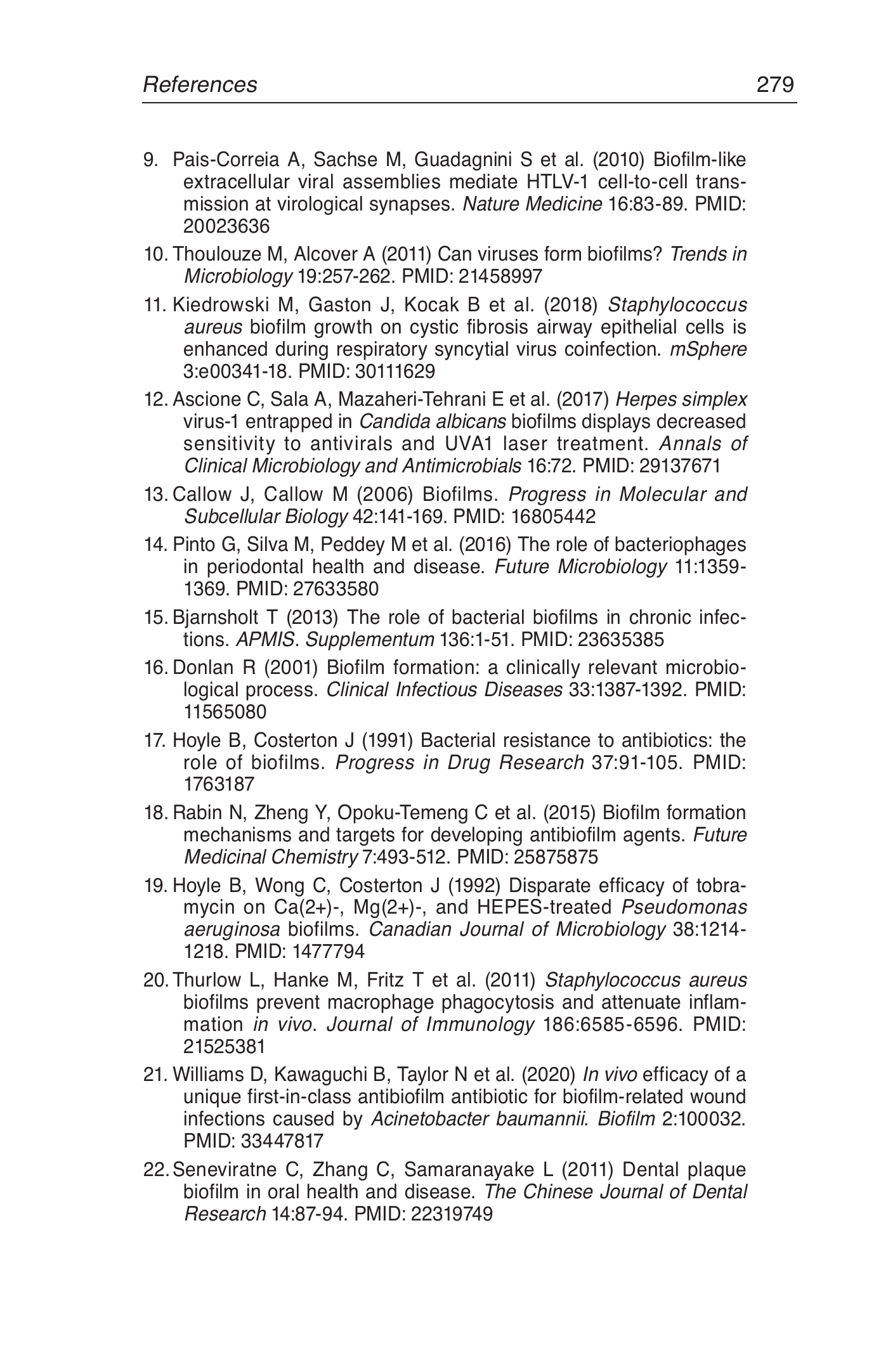
9. Pais-Correia A, Sachse M, Guadagnini S et al. (2010) Biofilm-like extracellular viral assemblies mediate HTLV-1 cell-to-cell trans- mission at virological synapses. Nature Medicine 16:83-89. PMID: 20023636 10. Thoulouze M, Alcover A (2011) Can viruses form biofilms? Trends in Microbiology 19:257-262. PMID: 21458997 11. Kiedrowski M, Gaston J, Kocak B et al. (2018) Staphylococcus aureus biofilm growth on cystic fibrosis airway epithelial cells is enhanced during respiratory syncytial virus coinfection. mSphere 3:e00341-18. PMID: 30111629 12. Ascione C, Sala A, Mazaheri-Tehrani E et al. (2017) Herpes simplex virus-1 entrapped in Candida albicans biofilms displays decreased sensitivity to antivirals and UVA1 laser treatment. Annals of Clinical Microbiology and Antimicrobials 16:72. PMID: 29137671 13. Callow J, Callow M (2006) Biofilms. Progress in Molecular and Subcellular Biology 42:141-169. PMID: 16805442 14. Pinto G, Silva M, Peddey M et al. (2016) The role of bacteriophages in periodontal health and disease. Future Microbiology 11:1359- 1369. PMID: 27633580 15. Bjarnsholt T (2013) The role of bacterial biofilms in chronic infec- tions. APMIS. Supplementum 136:1-51. PMID: 23635385 16. Donlan R (2001) Biofilm formation: a clinically relevant microbio- logical process. Clinical Infectious Diseases 33:1387-1392. PMID: 11565080 17. Hoyle B, Costerton J (1991) Bacterial resistance to antibiotics: the role of biofilms. Progress in Drug Research 37:91-105. PMID: 1763187 18. Rabin N, Zheng Y, Opoku-Temeng C et al. (2015) Biofilm formation mechanisms and targets for developing antibiofilm agents. Future Medicinal Chemistry 7:493-512. PMID: 25875875 19. Hoyle B, Wong C, Costerton J (1992) Disparate efficacy of tobra- mycin on Ca(2+)-, Mg(2+)-, and HEPES-treated Pseudomonas aeruginosa biofilms. Canadian Journal of Microbiology 38:1214- 1218. PMID: 1477794 20. Thurlow L, Hanke M, Fritz T et al. (2011) Staphylococcus aureus biofilms prevent macrophage phagocytosis and attenuate inflam- mation in vivo. Journal of Immunology 186:6585-6596. PMID: 21525381 21. Williams D, Kawaguchi B, Taylor N et al. (2020) In vivo efficacy of a unique first-in-class antibiofilm antibiotic for biofilm-related wound infections caused by Acinetobacter baumannii. Biofilm 2:100032. PMID: 33447817 22. Seneviratne C, Zhang C, Samaranayake L (2011) Dental plaque biofilm in oral health and disease. The Chinese Journal of Dental Research 14:87-94. PMID: 22319749

Source page 281

Open original page 281 — full-size image

280 RAPID VIRUS RECOVERY

23. Hall-Stoodley L, Hu F, Gieseke A et al. (2006) Direct detection of bacterial biofilms on the middle-ear mucosa of children with chronic otitis media. JAMA 296:202-211. PMID: 16835426 24. Sochocka M, Zwolinska K, Leszek J (2017) The infectious etiology of Alzheimer’s disease. Current Neuropharmacology 15:996-1009. PMID: 28294067 25. Laugisch O, Johnen A, Maldonado A et al. (2018) Periodontal pathogens and associated intrathecal antibodies in early stages of Alzheimer’s disease. Journal of Alzheimer’s Disease 66:105-114. PMID: 30223397 26. Matsushita K, Yamada-Furukawa M, Kurosawa M, Shikama Y (2020) Periodontal disease and periodontal disease-related bacteria involved in the pathogenesis of Alzheimer’s disease. Journal of Inflammation Research 13:275-283. PMID: 32636667 27. Vigasova D, Nemergut M, Liskova B, Damborsky J (2021) Multi- pathogen infections and Alzheimer’s disease. Microbial Cell Factories 20:25. PMID: 33509204 28. James G, Swogger E, Wolcott R et al. (2008) Biofilms in chronic wounds. Wound Repair and Regeneration 16:37-44. PMID: 18086294 29. Kania R, Lamers G, Vonk M et al. (2008) Characterization of mucosal biofilms on human adenoid tissues. The Laryngoscope 118:128-134. PMID: 17975509 30. Nistico L, Kreft R, Gieseke A et al. (2011) Adenoid reservoir for pathogenic biofilm bacteria. Journal of Clinical Microbiology 49:1411-1420. PMID: 21307211 31. Vestby L, Gronseth T, Simm R, Nesse L (2020) Bacterial biofilm and its role in the pathogenesis of disease. Antibiotics 9:59. PMID: 32028684 32. Lanter B, Sauer K, Davies D (2014) Bacteria present in carotid arterial plaques are found as biofilm deposits which may contribute to enhanced risk of plaque rupture. mBio 5:e01206-14. PMID: 24917599 33. Snow D, Everett J, Mayer G et al. (2016) The presence of biofilm structures in atherosclerotic plaques of arteries from legs ampu- tated as a complication of diabetic foot ulcers. Journal of Wound Care 25:S16-S22. PMID: 26878370 34. Taymoortash A, Wollstein A, Lippert B et al. (2002) Bacteria and pathogenesis of human salivary calculus. Acta Oto-Laryngologica 122:210-214. PMID: 11936916 35. Schroder S, Eickhardt S, Bjarnsholt T et al. (2018) Morphological evidence of biofilm in chronic obstructive sialadenitis. The Journal of Laryngology and Otology 132:611-614. PMID: 29986787 36. Perez-Tanoira R, Aarnisalo A, Haapaniemi A et al. (2019) Bacterial biofilm in salivary stones. European Archives of Oto-Rhino- Laryngology 276:1815-1822. PMID: 31028534

Source page 282

Open original page 282 — full-size image

References 281

37. Kao W, Chole R, Ogden M (2020) Evidence of a microbial etiology for sialoliths. The Laryngoscope 130:69-74. PMID: 30861582 38. Crawford R, Rosales-Reyes R, Ramirez-Aguilar M et al. (2010) Gallstones play a significant role in Salmonella spp. Gallbladder colonization and carriage. Proceedings of the National Academy of Sciences of the United States of America 107:4353-4358. PMID: 20176950 39. Prouty A, Schwesinger W, Gunn J (2002) Biofilm formation and interaction with the surfaces of gallstones by Salmonella spp. Infection and Immunity 70:2640-2649. PMID: 11953406 40. Marshall J, Flechtner A, La Perle K, Gunn J (2014) Visualization of extracellular matrix components within sectioned Salmonella biofilms on the surface of human gallstones. PLoS One 9:e89243. PMID: 24551241 41. Swidsinski A, Weber J, Loening-Baucke V et al. (2005) Spatial organization and composition of the mucosal flora in patients with inflammatory bowel disease. Journal of Clinical Microbiology 43:3380-3389. PMID: 16000463 42. Swidsinski A, Loening-Baucke V, Herber A (2009) Mucosal flora in Crohn’s disease and ulcerative colitis—an overview. Journal of Physiology and Pharmacology 60 Suppl 6:61-71. PMID: 20224153 43. Motta J, Wallace J, Buret A et al. (2021) Gastrointestinal biofilms in health and disease. Nature Reviews. Gastroenterology & Hepatology Jan 28. Online ahead of print. PMID: 33510461 44. Li S, Konstantinov S, Smits R, Peppelenbosch M (2017) Bacterial biofilms in colorectal initiation and progression. Trends in Molecular Medicine 23:18-30. PMID: 27986421 45. Machado D, Castro J, Palmeira-de-Oliveira A et al. (2016) Bacterial vaginosis biofilms: challenges to current therapies and emerging solutions. Frontiers in Microbiology 6:1528. PMID: 26834706 46. Castro J, Machado D, Cerca N (2019) Unveiling the role of Gardnerella vaginalis in polymicrobial bacterial vaginosis biofilms: the impact of other vaginal pathogens living as neighbors. The ISME Journal 13:1306-1317. PMID: 30670827 47. Swidsinski A, Verstraelen H, Loening-Baucke V et al. (2013) Presence of a polymicrobial endometrial biofilm in patients with bacterial vaginosis. PLoS One 8:e53997. PMID: 23320114 48. Ramakrishnan Y, Shields R, Elbadawey M, Wilson J (2015) Biofilms in chronic rhinosinusitis: what is new and where next? The Journal of Laryngology and Otology 129:744-751. PMID: 26120023 49. Manciula L, Jeican I, Tudoran L, Albu S (2020) Biofilms and inflammation in patients with chronic rhinosinusitis. Medicine and Pharmacy Reports 93:374-383. PMID: 33225263

Source page 283

Open original page 283 — full-size image

282 RAPID VIRUS RECOVERY

50. Kinnari T, Lampikoski H, Hyyrynen T, Aarnisalo A (2012) Bacterial biofilm associated with chronic laryngitis. Archives of Otolaryngology—Head & Neck Surgery 138:467-470. PMID: 22652944 51. Kinnari T (2015) The role of biofilm in chronic laryngitis and in head and neck cancer. Current Opinion in Otolaryngology & Head and Neck Surgery 23:448-453. PMID: 26371604 52. Singh P, Schaefer A, Parsek M et al. (2000) Quorum-sensing signals indicate that cystic fibrosis lungs are infected with bacte- rial biofilms. Nature 407:762-764. PMID: 11048725 53. Starner T, Zhang N, Kim G et al. (2006) Haemophilus influenzae forms biofilms on airway epithelia: implications in cystic fibrosis. American Journal of Respiratory and Critical Care Medicine 174:213-220. PMID: 16675778 54. Hoiby N, Ciofu O, Bjarnsholt T (2010) Pseudomonas aeruginosa biofilms in cystic fibrosis. Future Microbiology 5:1663-1674. PMID: 21133688 55. Hector A, Frey N, Hartl D (2016) Update on host-pathogen inter- actions in cystic fibrosis lung disease. Molecular and Cellular Pediatrics 3:12. PMID: 26905568 56. Scott V, Haake D, Churchill B et al. (2015) Intracellular bacterial communities: a potential etiology for chronic lower urinary tract symptoms. Urology 86:425-431. PMID: 26189137 57. Kanamura S, Kurazono H, Terai A et al. (2006) Increased biofilm formation in Escherichia coli isolated from acute prostatitis. International Journal of Antimicrobial Agents 28 Suppl 1:S21-S25. PMID: 16828264 58. Mazzoli S (2010) Biofilms in chronic bacterial prostatitis (NIH-II) and in prostatic calcifications. FEMS Immunology and Medical Microbiology 59:337-344. PMID: 20298500 59. Bartoletti R, Cai T, Nesi G et al. (2014) The impact of biofilm-pro- ducing bacteria on chronic bacterial prostatitis treatment: results from a longitudinal cohort study. World Journal of Urology 32:737- 742. PMID: 23918259 60. Cai T, Tessarolo F, Caola I et al. (2018) Prostate calcifications: a case series supporting the microbial biofilm theory. Investigative and Clinical Urology 59:187-193. PMID: 29744476 61. Davis S, Ricotti C, Cazzaniga A et al. (2008) Microscopic and phys- iologic evidence for biofilm-associated wound colonization in vivo. Wound Repair and Regeneration 16:23-29. PMID: 18211576 62. Barnes B, Galton L (1976) Hypothyroidism: The Unsuspected Illness. New York, NY: Harper & Row 63. Glynn A, O’Donnell S, Molony D et al. (2009) Hydrogen peroxide induced repression of icaADBC transcription and biofilm devel- opment in Staphylococcus epidermidis. Journal of Orthopaedic Research 27:627-630. PMID: 18942741

Source page 284

Open original page 284 — full-size image

References 283

64. Wu Y, Zhu H, Willcox M, Stapleton F (2011) Impact of cleaning regimens in silver-impregnated and hydrogen peroxide lens cases. Eye & Contact Lens 37:365-369. PMID: 21983551 65. Lineback C, Nkemngong C, Wu S et al. (2018) Hydrogen peroxide and sodium hypochlorite disinfectants are more effective against Staphylococcus aureus and Pseudomonas aeruginosa biofilms than quaternary ammonium compounds. Antimicrobial Resistance and Infection Control 7:154. PMID: 30568790 66. Watson F, Keevil C, Wilks S, Chewins J (2018) Modelling vapo- rised hydrogen peroxide efficacy against mono-species biofilms. Scientific Reports 8:12257. PMID: 30115938 67. Clifford D, Repine J (1982) Hydrogen peroxide mediated killing of bacteria. Molecular and Cellular Biochemistry 49:143-149. PMID: 6298593 68. Zhu G, Wang Q, Lu S, Niu Y (2017) Hydrogen peroxide: a potential wound therapeutic target? Medical Principles and Practice 26:301- 308. PMID: 28384636 69. Knight G, McIntyre J, Craig G et al. (2008) The inability of Streptococcus mutans and Lactobacillus acidophilus to form a biofilm in vitro on dentine pretreated with ozone. Australian Dental Journal 53:349-353. PMID: 19133951 70. Suh Y, Patel S, Kaitlyn R et al. (2019) Clinical utility of ozone therapy in dental and oral medicine. Medical Gas Research 9:163- 167. PMID: 31552882 71. Tonon C, Panariello B, Spolidorio D et al. (2020) Anti-biofilm effect of ozonized physiological saline solution on peri-implant-related biofilm. Journal of Periodontology Nov 24. Online ahead of print. PMID: 33231303 72. Rowen R (2019) Ozone and oxidation therapies as a solution to the emerging crisis in infectious disease management: a review of current knowledge and experience. Medical Gas Research 9:232- 237. PMID: 31898609 73. Eydou Z, Jad B, Elsayed Z et al. (2020) Investigation on the effect of vitamin C on growth & biofilm-forming potential of Streptococcus mutans isolated from patients with dental caries. BMC Microbiology 20:231. PMID: 32731889 74. Kirmusaoglu S, Kasikci H (2020) Identification of ica-dependent biofilm production by Staphylococcus aureus clinical isolates and antibiofilm effects of ascorbic acid against biofilm production. Journal of Clinical Pathology 73:261-266. PMID: 32213553 75. Silva H, de Souza G, Fernandes J et al. (2020) Unravelling the effects of the food components ascorbic acid and capsaicin as a novel anti-biofilm agent against Escherichia coli. Journal of Food Science and Technology 57:1013-1020. PMID: 32123422

Source page 285

Open original page 285 — full-size image

284 RAPID VIRUS RECOVERY

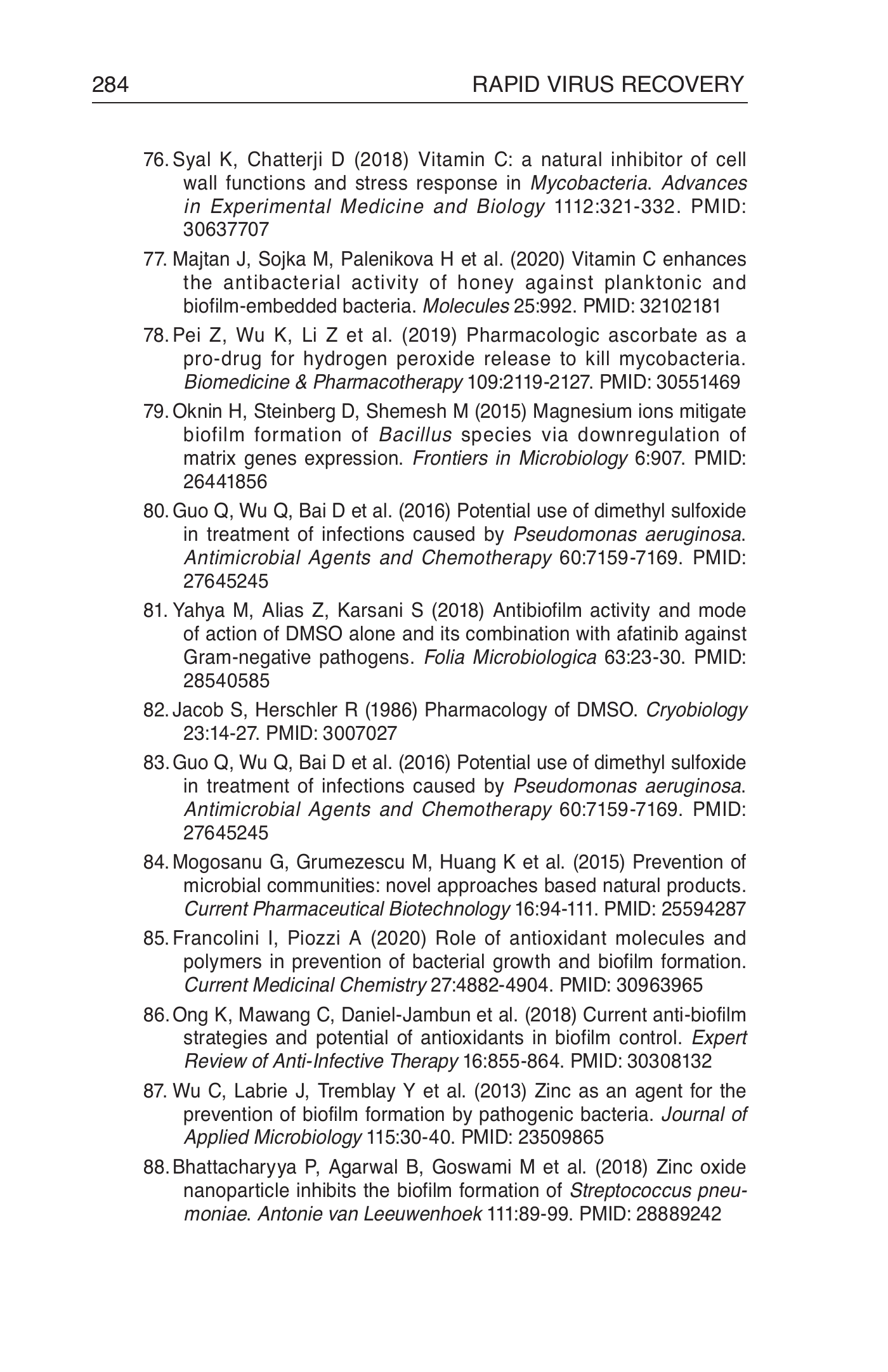
76. Syal K, Chatterji D (2018) Vitamin C: a natural inhibitor of cell wall functions and stress response in Mycobacteria. Advances in Experimental Medicine and Biology 1112:321-332. PMID: 30637707 77. Majtan J, Sojka M, Palenikova H et al. (2020) Vitamin C enhances the antibacterial activity of honey against planktonic and biofilm-embedded bacteria. Molecules 25:992. PMID: 32102181 78. Pei Z, Wu K, Li Z et al. (2019) Pharmacologic ascorbate as a pro-drug for hydrogen peroxide release to kill mycobacteria. Biomedicine & Pharmacotherapy 109:2119-2127. PMID: 30551469 79. Oknin H, Steinberg D, Shemesh M (2015) Magnesium ions mitigate biofilm formation of Bacillus species via downregulation of matrix genes expression. Frontiers in Microbiology 6:907. PMID: 26441856 80. Guo Q, Wu Q, Bai D et al. (2016) Potential use of dimethyl sulfoxide in treatment of infections caused by Pseudomonas aeruginosa. Antimicrobial Agents and Chemotherapy 60:7159-7169. PMID: 27645245 81. Yahya M, Alias Z, Karsani S (2018) Antibiofilm activity and mode of action of DMSO alone and its combination with afatinib against Gram-negative pathogens. Folia Microbiologica 63:23-30. PMID: 28540585 82. Jacob S, Herschler R (1986) Pharmacology of DMSO. Cryobiology 23:14-27. PMID: 3007027 83. Guo Q, Wu Q, Bai D et al. (2016) Potential use of dimethyl sulfoxide in treatment of infections caused by Pseudomonas aeruginosa. Antimicrobial Agents and Chemotherapy 60:7159-7169. PMID: 27645245 84. Mogosanu G, Grumezescu M, Huang K et al. (2015) Prevention of microbial communities: novel approaches based natural products. Current Pharmaceutical Biotechnology 16:94-111. PMID: 25594287 85. Francolini I, Piozzi A (2020) Role of antioxidant molecules and polymers in prevention of bacterial growth and biofilm formation. Current Medicinal Chemistry 27:4882-4904. PMID: 30963965 86. Ong K, Mawang C, Daniel-Jambun et al. (2018) Current anti-biofilm strategies and potential of antioxidants in biofilm control. Expert Review of Anti-Infective Therapy 16:855-864. PMID: 30308132 87. Wu C, Labrie J, Tremblay Y et al. (2013) Zinc as an agent for the prevention of biofilm formation by pathogenic bacteria. Journal of Applied Microbiology 115:30-40. PMID: 23509865 88. Bhattacharyya P, Agarwal B, Goswami M et al. (2018) Zinc oxide nanoparticle inhibits the biofilm formation of Streptococcus pneu- moniae. Antonie van Leeuwenhoek 111:89-99. PMID: 28889242


Book introduction and complete contents · Previous section · Previous part · Next part

References and final source page

Rapid Virus Recovery — Thomas E. Levy, MD, JD

Part 4 of 9; physical source pages 286–291.

Book introduction and complete contents · Previous section · Previous part · Next part
Unchanged original PDF


Source page 286

Open original page 286 — full-size image

References 285

89. Huang Z, Wu L, Li X et al. (2020) Zn(II) suppresses biofilm forma- tion in Bacillus amyloliquefaciens by inactivation of the Mn(II) uptake. Environmental Microbiology 22:1547-1558. PMID: 31715659 90. Vergalito F, Pietrangelo L, Petronio G et al. (2019) Vitamin E for prevention of biofilm-caused healthcare-associated infections. Open Medicine 15:14-21. PMID: 31922015 91. Bigliardi P, Alsagoff S, El-Kafrawi H et al. (2017) Povidone iodine in wound healing: a review of current concepts and practices. International Journal of Surgery 44:260-268. PMID: 28648795

Chapter 6 1. Zhou Y, Luo G (2019) Porphyromonas gingivalis and digestive system cancers. World Journal of Clinical Cases 7:819-829. PMID: 31024953 2. Mei F, Xie M, Huang X et al. (2020) Porphyromonas gingivalis and its systemic impact: current status. Pathogens 9:944. PMID: 33202751 3. Fiorillo L, Cervino G, Laino L et al. (2019) Porphyromonas gingi- valis, periodontal and systemic implications: a systematic review. Dentistry Journal 7:114. PMID: 31835888 4. Janakiram C, Mehta A, Venkitachalam R (2020) Prevalence of peri- odontal disease among adults in India: a systematic review and meta-analysis. Journal of Oral Biology and Craniofacial Research 10:800-806. PMID: 33204609 5. Nozawa A, Oshima H, Togawa N et al. (2020) Development of Oral Care Chip, a novel device for quantitative detection of the oral microbiota associated with periodontal disease. PLoS One 15:e0229485. PMID: 32109938 6. Romandini M, Baima G, Antonoglou G et al. (2020) Periodontitis, edentulism, and risk of mortality: a systematic review with meta-analysis. Journal of Dental Research Aug 31. Online ahead of print. PMID: 32866427 7. Larvin H, Kang J, Aggarwal V et al. (2020) Risk of incident cardio- vascular disease in people with periodontal disease: a system- atic review and meta-analysis. Clinical and Experimental Dental Research Oct 30. Online ahead of print. PMID: 33124761 8. Franek E, Napora M, Blach A et al. (2010) Blood pressure and left ventricular mass in subjects with type 2 diabetes and gingivitis or chronic periodontitis. Journal of Clinical Periodontology 37:875- 880. PMID: 20796107 9. Foratori-Junior G, Mascoli L, Marchese C et al. (2020) Association between arterial hypertension and periodontal status in morbidly obese patients who are candidates for bariatric surgery. International Dental Journal Oct 10. Online ahead of print. PMID: 33040359

Source page 287

Open original page 287 — full-size image

286 RAPID VIRUS RECOVERY

10. Pietropaoli D, Monaco A, D’Aiuto F et al. (2020) Acute gingival inflammation is linked to hypertension. Journal of Hypertension 38:2018-2027. PMID: 32890278 11. Beck J, Philips K, Moss K et al. (2020) Periodontal disease classifi- cations and incident coronary heart disease in the Atherosclerosis Risk in Communities study. Journal of Periodontology 91:1409- 1418. PMID: 32449797 12. Byon M, Kim S, Kim J et al. (2020) Association of periodontitis with atherosclerotic cardiovascular diseases: a nationwide popu- lation-based retrospective matched cohort study. International Journal of Environmental Research and Public Health 17:7261. PMID: 33020434 13. Nikolaeva E, Tsarev V, Tsareva T et al. (2019) Interrelation of cardiovascular diseases with anaerobic bacteria of subgingival biofilm. Contemporary Clinical Dentistry 10:637-642. PMID: 32792823 14. Aoyama N, Kure K, Minabe M, Izumi Y (2019) Increased heart failure prevalence in patients with a high antibody level against periodontal pathogen. International Heart Journal 60:1142-1146. PMID: 31447467 15. Sandi R, Pol K, Basavaraj P et al. (2014) Association of serum cholesterol, triglyceride, high and low density lipoprotein (HDL and LDL) levels in chronic periodontitis subjects with risk for cardiovascular disease (CVD): a cross sectional study. Journal of Clinical and Diagnostic Research 8:214-216. PMID: 24596778 16. Gomes-Filho I, Balinha I, da Cruz S et al. (2020) Moderate and severe periodontitis are positively associated with metabolic syndrome. Clinical Oral Investigations Nov 23. Online ahead of print. PMID: 33226499 17. Dewake N, Ishioka Y, Uchida K et al. (2020) Association between carotid artery calcification and periodontal disease progression in Japanese men and women: a cross-sectional study. Journal of Clinical Medicine 9:3365. PMID: 33092208 18. Jimenez M, Krall E, Garcia R et al. (2009) Periodontitis and inci- dence of cerebrovascular disease in men. Annals of Neurology 66:505-512. PMID: 19847898 19. Slowik J, Wnuk M, Grzech K et al. (2010) Periodontitis affects neurological deficit in acute stroke. Journal of the Neurological Sciences 297:82-84. PMID: 20723913 20. Lafon A, Pereira B, Dufour T et al. (2014) Periodontal disease and stroke: a meta-analysis of cohort studies. European Journal of Neurology 21:1155-1161. PMID: 24712659 21. Palm F, Lahdentausta L, Sorsa T et al. (2014) Biomarkers of peri- odontitis and inflammation in ischemic stroke: a case-control study. Innate Immunity 20:511-518. PMID: 24045341

Source page 288

Open original page 288 — full-size image

References 287

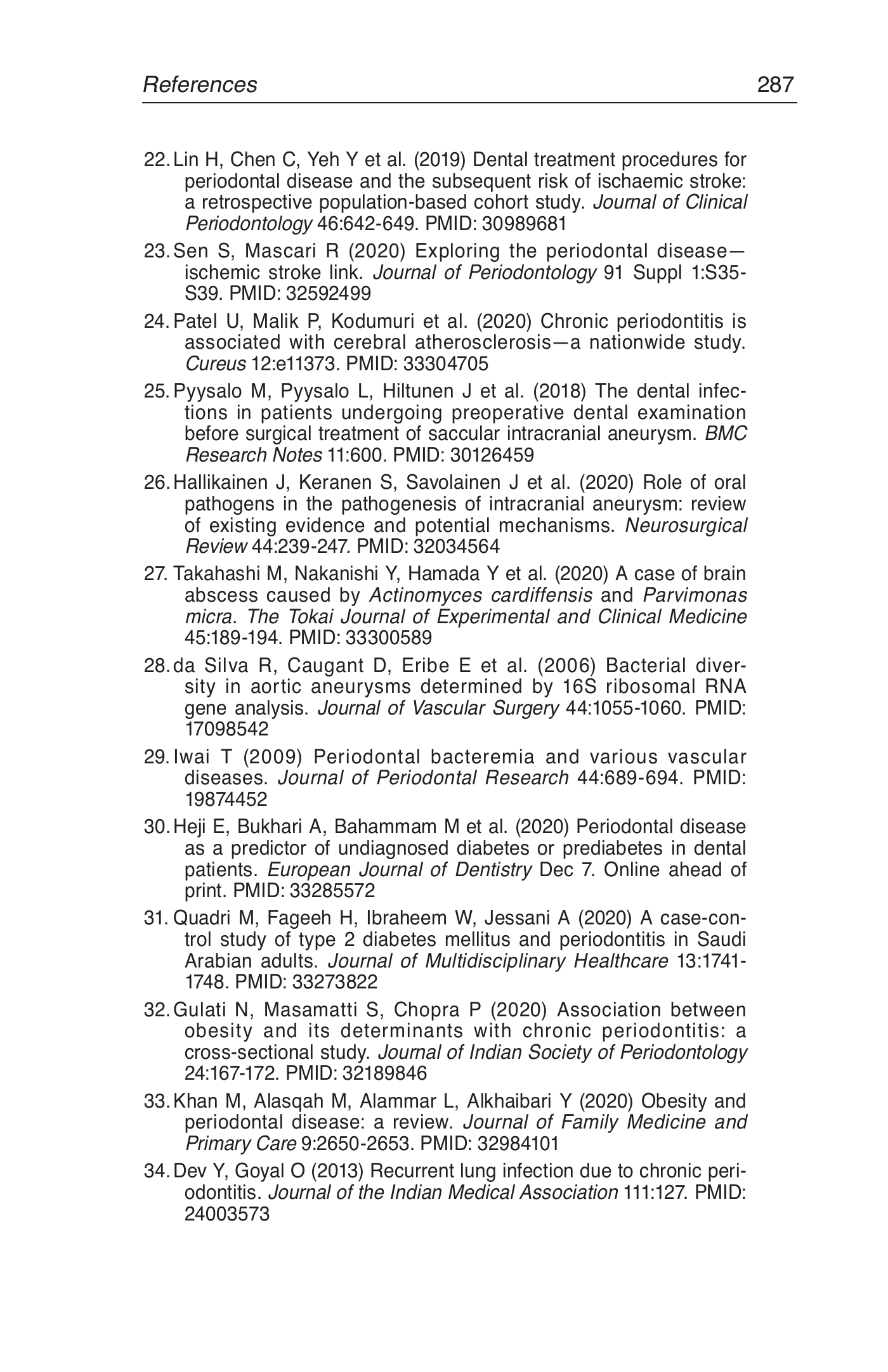
22. Lin H, Chen C, Yeh Y et al. (2019) Dental treatment procedures for periodontal disease and the subsequent risk of ischaemic stroke: a retrospective population-based cohort study. Journal of Clinical Periodontology 46:642-649. PMID: 30989681 23. Sen S, Mascari R (2020) Exploring the periodontal disease— ischemic stroke link. Journal of Periodontology 91 Suppl 1:S35- S39. PMID: 32592499 24. Patel U, Malik P, Kodumuri et al. (2020) Chronic periodontitis is associated with cerebral atherosclerosis—a nationwide study. Cureus 12:e11373. PMID: 33304705 25. Pyysalo M, Pyysalo L, Hiltunen J et al. (2018) The dental infec- tions in patients undergoing preoperative dental examination before surgical treatment of saccular intracranial aneurysm. BMC Research Notes 11:600. PMID: 30126459 26. Hallikainen J, Keranen S, Savolainen J et al. (2020) Role of oral pathogens in the pathogenesis of intracranial aneurysm: review of existing evidence and potential mechanisms. Neurosurgical Review 44:239-247. PMID: 32034564 27. Takahashi M, Nakanishi Y, Hamada Y et al. (2020) A case of brain abscess caused by Actinomyces cardiffensis and Parvimonas micra. The Tokai Journal of Experimental and Clinical Medicine 45:189-194. PMID: 33300589 28. da Silva R, Caugant D, Eribe E et al. (2006) Bacterial diver- sity in aortic aneurysms determined by 16S ribosomal RNA gene analysis. Journal of Vascular Surgery 44:1055-1060. PMID: 17098542 29. Iwai T (2009) Periodontal bacteremia and various vascular diseases. Journal of Periodontal Research 44:689-694. PMID: 19874452 30. Heji E, Bukhari A, Bahammam M et al. (2020) Periodontal disease as a predictor of undiagnosed diabetes or prediabetes in dental patients. European Journal of Dentistry Dec 7. Online ahead of print. PMID: 33285572 31. Quadri M, Fageeh H, Ibraheem W, Jessani A (2020) A case-con- trol study of type 2 diabetes mellitus and periodontitis in Saudi Arabian adults. Journal of Multidisciplinary Healthcare 13:1741- 1748. PMID: 33273822 32. Gulati N, Masamatti S, Chopra P (2020) Association between obesity and its determinants with chronic periodontitis: a cross-sectional study. Journal of Indian Society of Periodontology 24:167-172. PMID: 32189846 33. Khan M, Alasqah M, Alammar L, Alkhaibari Y (2020) Obesity and periodontal disease: a review. Journal of Family Medicine and Primary Care 9:2650-2653. PMID: 32984101 34. Dev Y, Goyal O (2013) Recurrent lung infection due to chronic peri- odontitis. Journal of the Indian Medical Association 111:127. PMID: 24003573

Source page 289

Open original page 289 — full-size image

288 RAPID VIRUS RECOVERY

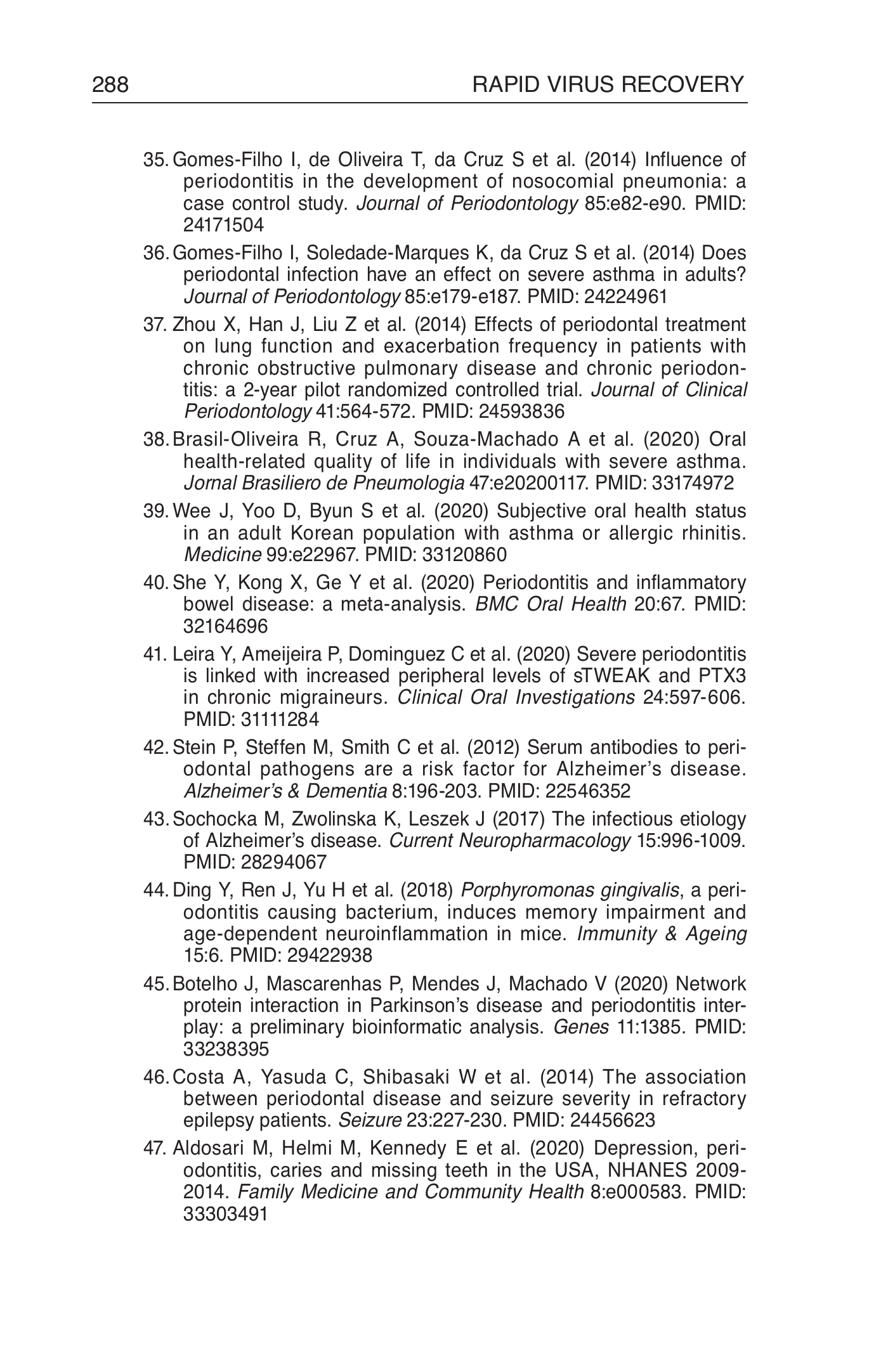
35. Gomes-Filho I, de Oliveira T, da Cruz S et al. (2014) Influence of periodontitis in the development of nosocomial pneumonia: a case control study. Journal of Periodontology 85:e82-e90. PMID: 24171504 36. Gomes-Filho I, Soledade-Marques K, da Cruz S et al. (2014) Does periodontal infection have an effect on severe asthma in adults? Journal of Periodontology 85:e179-e187. PMID: 24224961 37. Zhou X, Han J, Liu Z et al. (2014) Effects of periodontal treatment on lung function and exacerbation frequency in patients with chronic obstructive pulmonary disease and chronic periodon- titis: a 2-year pilot randomized controlled trial. Journal of Clinical Periodontology 41:564-572. PMID: 24593836 38. Brasil-Oliveira R, Cruz A, Souza-Machado A et al. (2020) Oral health-related quality of life in individuals with severe asthma. Jornal Brasiliero de Pneumologia 47:e20200117. PMID: 33174972 39. Wee J, Yoo D, Byun S et al. (2020) Subjective oral health status in an adult Korean population with asthma or allergic rhinitis. Medicine 99:e22967. PMID: 33120860 40. She Y, Kong X, Ge Y et al. (2020) Periodontitis and inflammatory bowel disease: a meta-analysis. BMC Oral Health 20:67. PMID: 32164696 41. Leira Y, Ameijeira P, Dominguez C et al. (2020) Severe periodontitis is linked with increased peripheral levels of sTWEAK and PTX3 in chronic migraineurs. Clinical Oral Investigations 24:597-606. PMID: 31111284 42. Stein P, Steffen M, Smith C et al. (2012) Serum antibodies to peri- odontal pathogens are a risk factor for Alzheimer’s disease. Alzheimer’s & Dementia 8:196-203. PMID: 22546352 43. Sochocka M, Zwolinska K, Leszek J (2017) The infectious etiology of Alzheimer’s disease. Current Neuropharmacology 15:996-1009. PMID: 28294067 44. Ding Y, Ren J, Yu H et al. (2018) Porphyromonas gingivalis, a peri- odontitis causing bacterium, induces memory impairment and age-dependent neuroinflammation in mice. Immunity & Ageing 15:6. PMID: 29422938 45. Botelho J, Mascarenhas P, Mendes J, Machado V (2020) Network protein interaction in Parkinson’s disease and periodontitis inter- play: a preliminary bioinformatic analysis. Genes 11:1385. PMID: 33238395 46. Costa A, Yasuda C, Shibasaki W et al. (2014) The association between periodontal disease and seizure severity in refractory epilepsy patients. Seizure 23:227-230. PMID: 24456623 47. Aldosari M, Helmi M, Kennedy E et al. (2020) Depression, peri- odontitis, caries and missing teeth in the USA, NHANES 2009- 2014. Family Medicine and Community Health 8:e000583. PMID: 33303491

Source page 290

Open original page 290 — full-size image

References 289

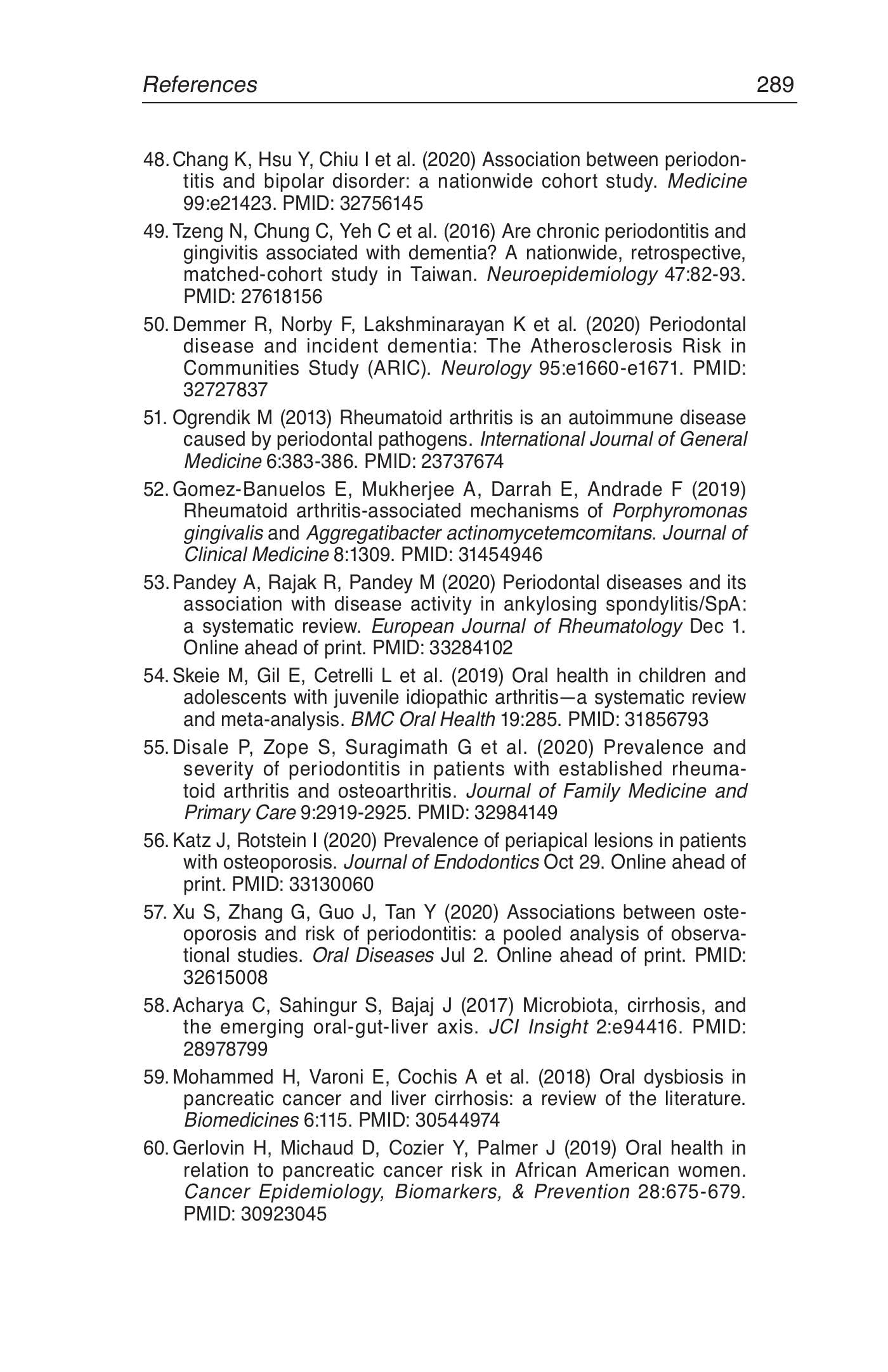
48. Chang K, Hsu Y, Chiu I et al. (2020) Association between periodon- titis and bipolar disorder: a nationwide cohort study. Medicine 99:e21423. PMID: 32756145 49. Tzeng N, Chung C, Yeh C et al. (2016) Are chronic periodontitis and gingivitis associated with dementia? A nationwide, retrospective, matched-cohort study in Taiwan. Neuroepidemiology 47:82-93. PMID: 27618156 50. Demmer R, Norby F, Lakshminarayan K et al. (2020) Periodontal disease and incident dementia: The Atherosclerosis Risk in Communities Study (ARIC). Neurology 95:e1660-e1671. PMID: 32727837 51. Ogrendik M (2013) Rheumatoid arthritis is an autoimmune disease caused by periodontal pathogens. International Journal of General Medicine 6:383-386. PMID: 23737674 52. Gomez-Banuelos E, Mukherjee A, Darrah E, Andrade F (2019) Rheumatoid arthritis-associated mechanisms of Porphyromonas gingivalis and Aggregatibacter actinomycetemcomitans. Journal of Clinical Medicine 8:1309. PMID: 31454946 53. Pandey A, Rajak R, Pandey M (2020) Periodontal diseases and its association with disease activity in ankylosing spondylitis/SpA: a systematic review. European Journal of Rheumatology Dec 1. Online ahead of print. PMID: 33284102 54. Skeie M, Gil E, Cetrelli L et al. (2019) Oral health in children and adolescents with juvenile idiopathic arthritis—a systematic review and meta-analysis. BMC Oral Health 19:285. PMID: 31856793 55. Disale P, Zope S, Suragimath G et al. (2020) Prevalence and severity of periodontitis in patients with established rheuma- toid arthritis and osteoarthritis. Journal of Family Medicine and Primary Care 9:2919-2925. PMID: 32984149 56. Katz J, Rotstein I (2020) Prevalence of periapical lesions in patients with osteoporosis. Journal of Endodontics Oct 29. Online ahead of print. PMID: 33130060 57. Xu S, Zhang G, Guo J, Tan Y (2020) Associations between oste- oporosis and risk of periodontitis: a pooled analysis of observa- tional studies. Oral Diseases Jul 2. Online ahead of print. PMID: 32615008 58. Acharya C, Sahingur S, Bajaj J (2017) Microbiota, cirrhosis, and the emerging oral-gut-liver axis. JCI Insight 2:e94416. PMID: 28978799 59. Mohammed H, Varoni E, Cochis A et al. (2018) Oral dysbiosis in pancreatic cancer and liver cirrhosis: a review of the literature. Biomedicines 6:115. PMID: 30544974 60. Gerlovin H, Michaud D, Cozier Y, Palmer J (2019) Oral health in relation to pancreatic cancer risk in African American women. Cancer Epidemiology, Biomarkers, & Prevention 28:675-679. PMID: 30923045

Source page 291

Open original page 291 — full-size image

290 RAPID VIRUS RECOVERY

61. Wang L, Yang X, Zou X et al. (2020) Relationship between peri- odontal disease and lung cancer: a systematic review and meta-analysis. Journal of Periodontal Research 55:581-593. PMID: 32583879 62. Chen Y, Yang Y, Zhu B et al. (2020) Association between peri- odontal disease, tooth loss and liver diseases risk. Journal of Clinical Periodontology 47:1053-1063. PMID: 32621350 63. Di Spirito F, Toti P, Pilone V et al. (2020) The association between periodontitis and human colorectal cancer: genetic and patho- genic linkage. Life 10:211. PMID: 32962181 64. Xuen K, Jha A, Zhao T et al. (2020) Is periodontal disease asso- ciated with increased risk of colorectal cancer? A meta-analysis. International Journal of Dental Hygiene Dec 2. Online ahead of print. PMID: 33269543 65. Kawasaki M, Ikeda Y, Ikeda E et al. (2020) Oral infectious bacteria in dental plaque and saliva as risk factors in patients with esoph- ageal cancer. Cancer Nov 6. Online ahead of print. PMID: 33156979 66. Velly A, Franco E, Schlecht N et al. (1998) Relationship between dental factors and risk of upper aerodigestive tract cancer. Oral Oncology 34:284-291. PMID: 9813724 67. Kageyama S, Takeshita T, Takeuchi K et al. (2019) Characteristics of the salivary microbiota in patients with various digestive tract cancers. Frontiers in Microbiology 10:1780. PMID: 31428073 68. Mathur R, Singhavi H, Malik A et al. (2019) Role of poor oral hygiene in causation of oral cancer—a review of literature. Indian Journal of Surgical Oncology 10:184-195. PMID: 30948897 69. Gopinath D, Menon R, Veettil S et al. (2020) Periodontal diseases as putative risk factors for head and neck cancer: systematic review and meta-analysis. Cancers 12:1893. PMID: 32674369 70. Payao S, Rasmussen L (2016) Helicobacter pylori and its reser- voirs: a correlation with the gastric infection. World Journal of Gastrointestinal Pharmacology and Therapeutics 7:126-132. PMID: 26855818 71. Ma H, Zheng J, Li X (2020) Potential risk of certain cancers among patients with periodontitis: a supplementary meta-analysis of a large-scale population. International Journal of Medical Sciences 17:2531-2543. PMID: 33029095 72. Sun J, Tan Q, Yu S et al. (2020) Role of the oral microbiota in cancer evolution and progression. Cancer Medicine 9:6306-6321. PMID: 32638533 73. Figuero E, Han Y, Furuichi Y (2020) Periodontal diseases and adverse pregnancy outcomes: mechanisms. African Health Sciences 83:175-188. PMID: 32385886


Book introduction and complete contents · Previous section · Previous part · Next part
References and final source page

Rapid Virus Recovery — Thomas E. Levy, MD, JD

Part 5 of 9; physical source pages 292–297.

Book introduction and complete contents · Previous section · Previous part · Next part

Unchanged original PDF


Source page 292

Open original page 292 — full-size image

References 291

74. Heo J, Ahn K, Park J (2020) Radiological screening of maternal periodontitis for predicting adverse pregnancy and neonatal outcomes. Scientific Reports 10:21266. PMID: 33277556 75. Kothiwale S, Desai B, Kothiwale V et al. (2014) Periodontal disease as a potential risk factor for low birth weight and reduced maternal haemoglobin levels. Oral Health & Preventive Dentistry 12:83-90. PMID: 24619787 76. Wu D, Lin Z, Zhang S et al. (2020) Decreased hemoglobin concen- tration and iron metabolism disorder in periodontitis: systematic review and meta-analysis. Frontiers in Physiology 10:1620. PMID: 32082180 77. Adulaijan H, Cohen R, Stellrecht E et al. (2020) Relationship between hypothyroidism and periodontitis: a scoping review. Clinical and Experimental Dental Research 6:147-157. PMID: 32067402 78. Chau S, Lee C, Huang J et al. (2020) The existence of periodontal disease and subsequent ocular diseases: a population-based cohort study. Medicina 56:621. PMID: 33218003 79. Sun K, Shen T, Chen S et al. (2020) Periodontitis and the subse- quent risk of glaucoma: results from the real-world practice. Scientific Reports 10:17568. PMID: 33067540 80. Wu C, Yang T, Lin H et al. (2013) Sudden sensorineural hearing loss associated with chronic periodontitis: a population-based study. Otology & Neurotology 34:1380-1384. PMID: 24026022 81. Costa A, Cota L, Mendes V et al. (2020) Periodontitis and the impact of oral health on the quality of life of psoriatic individuals: a case-control study. Clinical Oral Investigations Sep 21. Online ahead of print. PMID: 32955692 82. Young H, Ward W (2020) The relationship between polycystic ovarian syndrome, periodontal disease, and osteoporosis. Reproductive Sciences Sep 10. Online ahead of print. PMID: 32914348 83. Lee J, Jeong S (2020) A population-based study on the association between periodontal disease and major lifestyle-related comor- bidities in South Korea: an elderly cohort study from 2002-2015. Medicina 56:575. PMID: 33138320 84. Machado V, Lopes J, Patrao M et al. (2020) Validity of the asso- ciation between periodontitis and female infertility conditions: a concise review. Reproduction 160:R41-R54. PMID: 32716008 85. Hickey N, Shalamanova L, Whitehead K et al. (2020) Exploring the putative interactions between chronic kidney disease and chronic periodontitis. Critical Reviews in Microbiology 46:61-77. PMID: 32046541 86. Schutz J, Azambuja C, Cunha G et al. (2020) Association between severe periodontitis and chronic kidney disease severity in predi- alytic patients: a cross-sectional study. Oral Diseases 26:447-456. PMID: 31742816

Source page 293

Open original page 293 — full-size image

292 RAPID VIRUS RECOVERY

87. Yue H, Xu X, Liu Q et al. (2020) Effects of non-surgical periodontal therapy on systemic inflammation and metabolic markers in patients undergoing haemodialysis and/or peritoneal dialysis: a systematic review and meta-analysis. BMC Oral Health 20:18. PMID: 31969148 88. Degasperi G, Ossick M, Pinheiro S, Etchegaray A (2020) Autoimmunity and periodontal disease: arguing a possible correlation. Indian Journal of Dental Research 31:615-620. PMID: 33107465 89. Benli M, Batool F, Stutz C et al. (2019) Orofacial manifestations and dental management of systemic lupus erythematosus: a review. Oral Diseases Dec 30. Online ahead of print. PMID: 31886584 90. Pessoa L, Aleti G, Choudhury S et al. (2019) Host-microbial interac- tions in systemic lupus erythematosus and periodontitis. Frontiers in Immunology 10:2602. PMID: 31781106 91. Manchery N, Henry J, Nangle M (2020) A systematic review of oral health in people with multiple sclerosis. Community Dentistry and Oral Epidemiology 48:89-100. PMID: 31815299 92. Costa F, Esteves-Lima R, Cortelli S et al. (2020) Effect of compli- ance during periodontal maintenance therapy on C-reactive protein levels: a 6 -year follow-up. Journal of Clinical Periodontology Dec 1. Online ahead of print. PMID: 33259118 93. Esteves-Lima R, Reis C, Santirocchi-Junior F et al. (2020) Association between periodontitis and serum C-reactive protein levels. Journal of Clinical and Experimental Dentistry 12:e838- e843. PMID: 32994872 94. Gupta S, Suri P, Patil P et al. (2020) Comparative evaluation of role of hs-C-reactive protein as a diagnostic marker in chronic peri- odontitis patients. Journal of Family Medicine and Primary Care 9:1340-1347. PMID: 32509613 95. Isola G, Alibrandi A, Rapisarda E et al. (2020) Association of vitamin D in patients with periodontitis: a cross-sectional study. Journal of Periodontal Research 55:602-612. PMID: 32173876 96. Munday M, Rodricks R, Fitzpatrick M et al. (2020) A pilot study examining vitamin C levels in periodontal patients. Nutrients 12:2255. PMID: 32731485 97. Richenbacher O, Filippi C, Zurcher A, Filippi A (2019) Acceptance of a tongue vacuum cleaner among children and evaluation of tongue cleaning at home. Swiss Dental Journal 129:102-107. PMID: 30647023 98. Kulacz R, Levy T (2014) The Toxic Tooth: How a root canal could be making you sick, Henderson, NV: MedFox Publishing 99. Levy T (2017) Hidden Epidemic: Silent oral infections cause most heart attacks and breast cancers, Henderson, NV: MedFox Publishing

Source page 294

Open original page 294 — full-size image

References 293

100. Gao L, Liu P, Song J (2010) [Relationship between tongue presen- tations and serum level of C-reactive protein in patients with acute cerebral infarction]. Article in Chinese. Chinese Journal of Integrated Traditional and Western Medicine 30:1146-1148. PMID: 21275163 101. Pedrazzi V, Sato S, de Mattos M et al. (2004) Tongue-cleaning methods: a comparative clinical trial employing a toothbrush and a tongue scraper. Journal of Periodontology 75:1009-1012. PMID: 15341360 102. Outhouse T, Fedorowicz Z, Keenan J, Al-Alawi R (2006) A Cochrane systematic review finds tongue scrapers have short- term efficacy in controlling halitosis. General Dentistry 54:352- 360. PMID: 17004573 103. Danser M, Gomez S, Van der Weijden G (2003) Tongue coating and tongue brushing: a literature review. International Journal of Dental Hygiene 1:151-158. PMID: 16451515 104. Amou T, Hinode D, Yoshioka M, Grenier D (2014) Relationship between halitosis and periodontal disease—associated oral bacteria in tongue coatings. International Journal of Dental Hygiene 12:145-151. PMID: 23890391 105. Cherel F, Mobilia A, Lundgren T et al. (2008) Rate of reformation of tongue coatings in young adults. International Journal of Dental Hygiene 6:371-375. PMID: 19138189

Chapter 8 1. Lee S (2015) Intestinal permeability regulation by tight junction: implication on inflammatory bowel diseases. Intestinal Research 13:11-18. PMID: 25691839 2. Kelly C, Bai J, Liu E, Leffler D (2015) Advances in diagnosis and management of celiac disease. Gastroenterology 148:1175-1186. PMID: 25662623 3. Ye B, McGovern D (2016) Genetic variation in IBD: progress, clues to pathogenesis and possible clinical utility. Expert Review of Clinical Immunology 12:1091-1107. PMID: 27156530 4. Bhattarai Y, Pedrogo D, Kashyap P (2017) Irritable bowel syndrome: a gut microbiota-related disorder? American Journal of Physiology. Gastrointestinal and Liver Physiology 312:G52-G62. PMID: 27881403 5. Rogler G, Hausmann M (2019) The long and winding road: from genetic risk factors to the understanding of disease-pathogen- esis in Crohn’s disease. Genes and Immunity 20:607-608. PMID: 30773533

Source page 295

Open original page 295 — full-size image

294 RAPID VIRUS RECOVERY

Chapter 9 1. Schooley R (2018) The human microbiome: implications for health and disease, including HIV infection. Topics in Antiviral Medicine 26:75-78. PMID: 3038432 2. Lezutekong J, Nikhanj A, Oudit G (2018) Imbalance of gut micro- biome and intestinal epithelial barrier dysfunction in cardiovas- cular disease. Clinical Science 132:901-904. PMID: 29712884 3. Obrenovich M (2018) Leaky gut, leaky brain? Microorganisms 6:107. PMID: 30340384 4. Belkaid Y, Harrison O (2017) Homeostatic immunity and the micro- biota. Immunity 46:562-576. PMID: 28423337 5. Barko P, McMichael M, Swanson K, Williams D (2018) The gastro- intestinal microbiome: a review. Journal of Veterinary Internal Medicine 32:9-25. PMID: 29171095 6. Maruvada P, Leone V, Kaplan L, Chang E (2017) The human micro- biome and obesity: moving beyond associations. Cell Host & Microbe 22:589-599. PMID: 29120742 7. Pushalkar S, Hundeyin M, Daley D et al. (2018) The pancreatic cancer microbiome promotes oncogenesis by induction of innate and adaptive immune suppression. Cancer Discovery 8:403-416. PMID: 29567829 8. Aykut B, Pushalkar S, Chen R et al. (2019) The fungal microbiome promotes pancreatic oncogenesis via activation of MBL. Nature 574:264-267. PMID: 31578522 9. Mendoza L (2019) Potential effect of probiotics in the treatment of breast cancer. Oncology Reviews 13:422. PMID: 31583054 10. Song M, Chan A, Sun J (2020) Influence of the gut micro- biome, diet, and environment on risk of colorectal cancer. Gastroenterology 158:322-340. PMID: 31586566 11. Kitai T, Kirsop J, Tang W (2016) Exploring the microbiome in heart failure. Current Heart Failure Reports 13:103-109. PMID: 26886380 12. Fandriks L (2017) Roles of the gut in the metabolic syndrome: an overview. Journal of Internal Medicine 281:319-336. PMID: 27991713 13. Barna I, Nyul D, Szentes T, Schwab R (2018) [Review of the relation between gut microbiome, metabolic disease and hyper- tension]. Article in Hungarian. Orvosi Hetilap 159:346-351. PMID: 29480046 14. Neuman H, Koren O (2017) The pregnancy microbiome. Nestle Nutrition Institute Workshop Series 88:1-9. PMID: 28346919 15. Zhang J, Ma S, Wu S et al. (2019) Effects of probiotic supplement in pregnant women with gestational diabetes mellitus: a system- atic review and meta-analysis of randomized controlled trials. Journal of Diabetes Research 2019:5364730. PMID: 31583250

Source page 296

Open original page 296 — full-size image

References 295

16. Ipci K, Altintoprak N, Muluk N et al. (2017) The possible mecha- nisms of the human microbiome in allergic diseases. European Archives of Oto-Rhino-Laryngology 274:617-626. PMID: 27115907 17. Santos S, Konstantyner T, Cocco R (2020) Effects of probiotics in the treatment of food hypersensitivity in children: a system- atic review. Allergologia et Immunopathologia 48:95-104. PMID: 31477401 18. Kohling H, Plummer S, Marchesi J et al. (2017) The microbiota and autoimmunity: their role in thyroid autoimmune diseases. Clinical Immunity 183:63-74. PMID: 28689782 19. Yurtdas G, Akdevelioglu Y (2019) A new approach to polycystic ovary syndrome: the gut microbiota. Journal of the American College of Nutrition 12:1-12. PMID: 31513473 20. Gareau M (2016) Cognitive function and the microbiome. International Review of Neurobiology 131:227-246. PMID: 27793221 21. Winek K, Dirnagl U, Meisel A (2016) The gut microbiome as thera- peutic target in central nervous system diseases: implications for stroke. Neurotherapeutics 13:762-774. PMID: 27714645\ 22. Zheng P, Zeng B, Zhou C et al. (2016) Gut microbiome remodeling induces depressive-like behaviors through a pathway mediated by the host’s metabolism. Molecular Psychiatry 21:786-796. PMID: 27067014 23. Quigley E (2017) Microbiota-brain-gut axis and neurodegenerative diseases. Current Neurology and Neuroscience Reports 17:94. PMID: 29039142 24. Naghibi M, Day R, Stone S, Harper A (2019) Probiotics for the prophylaxis of migraine: a systematic review of randomized placebo controlled trials. Journal of Clinical Medicine 8:1441. PMID: 31514352 25. Simkin D (2019) Microbiome and mental health, specifically as it relates to adolescents. Current Psychiatry Reports 21:93. PMID: 31478105 26. Srikantha P, Mohajeri M (2019) The possible role of the micro- biota-gut-brain-axis in autism spectrum disorder. International Journal of Molecular Sciences 20:2115. PMID: 31035684 27. Ding F, Karkhaneh M, Zorzela L et al. (2019) Probiotics for paediatric functional abdominal pain disorders: a rapid review. Paediatrics & Child Health 24:383-394. PMID: 31528110 28. Glassner K, Abraham B, Quigley E (2020) The microbiome and inflammatory bowel disease. The Journal of Allergy and Clinical Immunology 145:16-27. PMID: 31910984 29. Tuomisto S, Pessi T, Collin P et al. (2014) Changes in gut bacte- rial populations and their translocation into liver and ascites in alcoholic liver cirrhotics. BMC Gastroenterology 14:40. PMID: 24564202

Source page 297

Open original page 297 — full-size image

296 RAPID VIRUS RECOVERY

30. Victor D, Quigley E (2016) The microbiome and the liver: the basics. Seminars in Liver Disease 36:299-305. PMID: 27997968 31. Joyce S, Gahan C (2017) Disease-associated changes in bile acid profiles and links to altered gut microbiota. Digestive Diseases 35:169-177. PMID: 28249284 32. Adolph T, Grander C, Moschen A, Tilg H (2018) Liver-microbiome axis in health and disease. Trends in Immunology 39:712-713. PMID: 29843959 33. Gadelha C, Bezerra A (2019) Effects of probiotics on the lipid profile: systematic review. Jornal Vascular Brasiliero 18:e20180124. PMID: 31447899 34. Tiderencel K, Hutcheon D, Ziegler J (2020) Probiotics for the treat- ment of type 2 diabetes: a review of randomized controlled trials. Diabetes/Metabolism Research and Reviews 36:e3213. PMID: 31465625 35. Costello M, Robinson P, Benham H, Brown M (2015) The intes- tinal microbiome in human disease and how it relates to arthritis and spondyloarthritis. Best Practice and Research. Clinical Rheumatology 29:202-212. PMID: 26362739 36. Verwoerd A, Haar N, de Roock S et al. (2016) The human micro- biome and juvenile idiopathic arthritis. Pediatric Rheumatology Online Journal 14:55. PMID: 27650128 37. Rosenbaum J, Asquith M (2016) The microbiome: a revolution in treatment for rheumatic diseases? Current Rheumatology Reports 18:62. PMID: 27641915 38. Chotirmall S, Gellatly S, Budden K et al. (2017) Microbiomes in respiratory health and disease: an Asia-Pacific perspective. Respirology 22:240-250. PMID: 28102970 39. Salisbury M, Han M, Dickson R, Molyneaux P (2017) The micro- biome in interstitial lung disease: from pathogenesis to treatment target. Current Opinion in Pulmonary Medicine 23:404-410. PMID: 28650861 40. Wang L, Hao K, Yang T, Wang C (2017) Role of the lung micro- biome in the pathogenesis of chronic obstructive pulmonary disease. Chinese Medical Journal 130:2107-2111. PMID: 28741603 41. Lu L, Liu J (2016) Human microbiota and ophthalmic disease. Yale Journal of Biology and Medicine 89:325-330. PMID: 27698616 42. Rowan S, Taylor A (2018) The role of microbiota in retinal disease. Advances in Experimental Medicine and Biology 1074:429-435. PMID: 29721973 43. Cantore S, Ballini A, De Vito D et al. (2018) Clinical results of improvement in periodontal condition by administration of oral probiotics. Journal of Biological Regulators and Homeostatic Agents 32:1329-1334. PMID: 30334434


Book introduction and complete contents · Previous section · Previous part · Next part

References and final source page

Rapid Virus Recovery — Thomas E. Levy, MD, JD

Part 6 of 9; physical source pages 298–303.

Book introduction and complete contents · Previous section · Previous part · Next part
Unchanged original PDF


Source page 298

Open original page 298 — full-size image

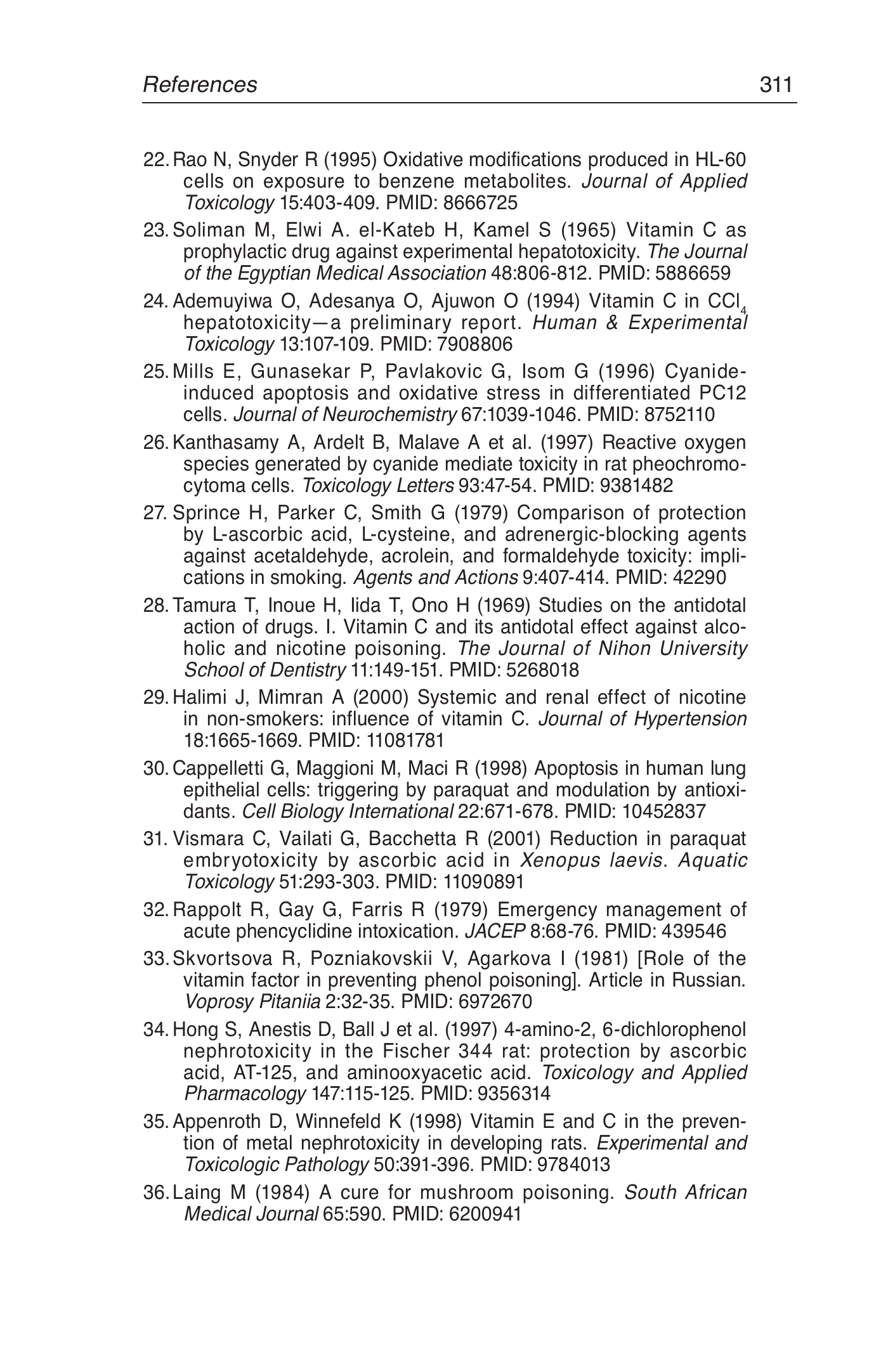
References 297

44. Inchingolo F, Dipalma G, Cirulli N et al. (2018) Microbiological results of improvement in periodontal condition by adminis- tration of oral probiotics. Journal of Biological Regulators and Homeostatic Agents 32:1323-1328. PMID: 30334433 45. Soares L, de Carvalho E, Tinoco E (2019) Clinical effect of Lactobacillus on the treatment of severe periodontitis and hali- tosis: a double-blinded, placebo-controlled, randomized clinical trial. American Journal of Dentistry 32:9-13. PMID: 30834725 46. John G, Mullin G (2016) The gut microbiome and obesity. Current Oncology Reports 18:45. PMID: 27255389 47. Crovesy L, Ostrowski M, Ferreira D et al. (2017) Effect of Lactobacillus on body weight and body fat in overweight subjects: a systematic review of randomized controlled clinical trials. International Journal of Obesity 41:1607-1614. PMID: 28792488 48. Menni C, Jackson M, Pallister T et al. (2017) Gut microbiome diversity and high-fibre intake are related to lower long-term weight gain. International Journal of Obesity 41:1099-1105. PMID: 28286339 49. Seganfredo F, Blume C, Moehlecke M et al. (2017) Weight-loss interventions and gut microbiota changes in overweight and obese patients: a systematic review. Obesity Reviews 18:832-851. PMID: 28524627 50. Khan S, Ansari F (2007) Probiotics—the friendly bacteria with market potential in global market. Pakistan Journal of Pharmaceutical Sciences 20:76-82. PMID: 17337434 51. Zhang Y, Leveille S, Edward J (2020) Wisdom teeth, periodontal disease, and C-reactive protein in US adults. Public Health 187:97-102. PMID: 32942171 52. Whittaker P, Tufaro P, Rader J (2001) Iron and folate in fortified cereals. Journal of the American College of Nutrition 20:247-254. PMID: 11444421 53. Reifen R, Matas Z, Zeidel L et al. (2000) Iron supplementation may aggravate inflammatory status of colitis in a rat model. Digestive Diseases and Sciences 45:394-397. PMID: 10711457 54. Carrier J, Aghdassi E, Platt I et al. (2001) Effect of iron supplemen- tation on oxidative stress and colonic inflammation in rats with induced colitis. Alimentary Pharmacology & Therapeutics 15:1989- 1999. PMID: 11736731 55. Yu S, Feng Y, Shen Z, Li M (2011) Diet supplementation with iron augments brain oxidative stress status in a rat model of psycho- logical stress. Nutrition 27:1048-1052. PMID: 21454054 56. Gao W, Li X, Gao Z, Li H (2014) Iron increases diabetes-induced kidney injury and oxidative stress in rats. Biological Trace Element Research 160:368-375. PMID: 24996958

Source page 299

Open original page 299 — full-size image

298 RAPID VIRUS RECOVERY

57. Volani C, Paglia G, Smarason S et al. (2018) Metabolic signature of dietary iron overload in a mouse model. Cells 7:264. PMID: 30544931 58. Korkmaz V, Ozkaya E, Seven B et al. (2014) Comparison of oxida- tive stress in pregnancies with and without first trimester iron supplement: a randomized double-blind controlled trial. Journal of Maternal-Fetal & Neonatal Medicine 27:1535-1538. PMID: 24199687 59. Lymperaki E, Tsikopoulos A, Makedou K et al. (2015) Impact of iron and folic acid supplementation on oxidative stress during preg- nancy. Journal of Obstetrics and Gynaecology 35:803-806. PMID: 25692315 60. Scholl T (2005) Iron status during pregnancy: setting the stage for mother and infant. The American Journal of Clinical Nutrition 81:1218S-1222S. PMID: 15883455 61. Tiwari A, Mahdi A, Chandyan S et al. (2011) Oral iron supplementa- tion leads to oxidative imbalance in anemic women: a prospective study. Clinical Nutrition 30:188-193. PMID: 20888091 62. Weinberg E (2000) Iron-enriched rice: the case for labeling. Journal of Medicinal Food 3:189-191. PMID: 19236176 63. Weinberg E (2009) Is addition of iron to processed foods safe for iron replete consumers? Medical Hypotheses 73:948-949. PMID: 19628337 64. Levy T (2019) Magnesium: Reversing Disease, Henderson, NV: MedFox Publishing 65. Lucas C, Barnich N, Nguyen H (2017) Microbiota, inflammation and colorectal cancer. International Journal of Molecular Sciences 18:1310. PMID: 28632155 66. Piotrowski I, Kulcenty K, Suchorska W (2020) Interplay between inflammation and cancer. Reports of Practical Oncology and Radiotherapy 25:422-427. PMID: 32372882

Chapter 10 1. Levy T (2011) Primal Panacea, Henderson, NV: MedFox Publishing 2. Marik P, Khangoora V, Rivera R et al. (2017) Hydrocortisone, vitamin C, and thiamine for the treatment of severe sepsis and septic shock. A retrospective before-after study. Chest 151:1229- 1238. PMID: 27940189 3. Vergauwen B, Herbert M, Van Beeumen J (2006) Hydrogen peroxide scavenging is not a virulence determinant in the patho- genesis of Haemophilus influenzae type b strain Eagan. BMC Microbiology 6:3. PMID: 16430767 4. Santos C, Bannitz-Fernandes R, Lima A et al. (2018) Monitoring H2O2 inside Aspergillus fumigatus with an integrated microelec- trode: the role of peroxiredoxin protein Prx1. Analytical Chemistry 90:2587-2593. PMID: 29345916

Source page 300

Open original page 300 — full-size image

References 299

5. Nishimura M (2016) High-flow nasal cannula oxygen therapy in adults: physiological benefits, indication, clinical benefits, and adverse effects. Respiratory Care 61:529-541. PMID: 27016353 6. Oliver T, Murphy D (1920) Influenzal pneumonia: the intravenous injection of hydrogen peroxide. The Lancet 195:432-433. 7. Levine M, Padayatty S, Espey M (2011) Vitamin C: a concentra- tion-function approach yields pharmacology and therapeutic discoveries. Advances in Nutrition 2:78-88. PMID: 22332036 8. Halliwell B, Clement M, Ramalingam J, Long L (2000) Hydrogen peroxide. Ubiquitous in cell culture and in vivo? IUBMD Life 50:251-257. PMID: 11327318 9. Yoon J, An S, Kyeong I et al., (2011) Oxidative modification of ferritin induced by hydrogen peroxide. BMB Reports 44:165-169. PMID: 21429293 10. Antunes F, Cadenas E (2000) Estimation of H2O2 gradients across biomembranes. FEBS Letters 475:121-126. PMID: 10858501 11. Chen Q, Espey M, Krishna M et al. (2005) Pharmacologic ascorbic acid concentrations selectively kill cancer cells: action as a pro-drug to deliver hydrogen peroxide to tissues. Proceedings of the National Academy of Sciences of the United States of America 102:13604-13609. PMID: 16157892 12. Chen Q, Espey M, Sun A et al. (2007) Ascorbate in pharmaco- logic concentrations selectively generates ascorbate radical and hydrogen peroxide in extracellular fluid in vivo. Proceedings of the National Academy of Sciences of the United States of America 104:8749-8754. PMID: 17502596 13. Root R (1975) H2O2 release from human granulocytes during phagocytosis: I. Documentation, quantitation, and some regu- lating factors. The Journal of Clinical Investigation 55:945-955. PMID: 1123431 14. Root R, Metcalf J (1977) H2O2 release from human granulocytes during phagocytosis. Relationship to superoxide anion forma- tion and cellular catabolism of H2O2: studies with normal and cytochalasin B-treated cells. The Journal of Clinical Investigation 60:1266-1279. PMID: 199619 15. Evans R, Currie L, Campbell A (1982) The distribution of ascorbic acid between various cellular components of blood, in normal indi- viduals, and its relation to the plasma concentration. The British Journal of Nutrition 47:473-482. PMID: 7082619 16. Carr A, Maggini S (2017) Vitamin C and immune function. Nutrients 9:1211. PMID: 29099763 17. Ang A, Pullar J, Currie M, Vissers M (2018) Vitamin C and immune cell function in inflammation and cancer. Biochemical Society Transactions 46:1147-1159. PMID: 30301842

Source page 301

Open original page 301 — full-size image

300 RAPID VIRUS RECOVERY

18. Pei Z, Wu K, Li Z et al. (2019) Pharmacologic ascorbate as a pro-drug for hydrogen peroxide release to kill mycobacteria. Biomedicine & Pharmacotherapy 109:2119-2127. PMID: 30551469 19. Rowen R, Robins H, Carew K et al. (2016) Rapid resolution of hemorrhagic fever (Ebola) in Sierra Leone with ozone therapy. African Journal of Infectious Diseases 10:49-54. 20. Gonzalez M, Miranda-Massari J, Berdiel M et al. (2014) High dose intravenous vitamin C and Chikungunya fever: a case report. Journal of Orthomolecular Medicine 29:154-156. 21. Marcial-Vega V, Gonzalez-Terron G, Levy T (2015) Intravenous ascorbic acid and hydrogen peroxide in the management of patients with Chikungunya. Bulletin of the Medical Association of Puerto Rico 107:20-24. PMID: 26035980 22. Gonzalez M, Berdiel M, Miranda-Massari J et al. (2016) High dose intravenous vitamin C treatment for Zika fever. Journal of Orthomolecular Medicine Volume 31. 23. Gonzalez M, Berdiel M, Duconge J et al. (2018) High dose intra- venous vitamin C and influenza: a case report. Journal of Orthomolecular Medicine Volume 33 24. Kashiouris M, L’Heureux M, Cable C et al. (2020) The emerging role of vitamin C as a treatment for sepsis. Nutrients 12:292. PMID: 31978969 25. Fowler A, Kim C, Lepler L et al. (2017) Intravenous vitamin C as adjunctive therapy for enterovirus/rhinovirus induced acute respi- ratory distress syndrome. World Journal of Critical Care Medicine 6:85-90. PMID: 28224112 26. Matthay M, Aldrich J, Gotts J (2020) Treatment for severe acute respiratory distress syndrome from COVID-19. The Lancet. Respiratory Medicine 8:433-434. PMID: 32203709 27. Zhao B, Ling Y, Li J et al. (2020) Beneficial aspects of high dose intravenous vitamin C on patients with COVID-19 pneumonia in severe condition: a retrospective case series study. Annals of Palliative Medicine Nov 17. Online ahead of print. PMID: 33222462 28. http://orthomolecular.org/resources/omns/index.shtml 29. Rose R, Pinkston P, Skornik W (1989) Altered susceptibility to viral respiratory infection during short-term exposure to nitrogen dioxide. Research Report (Health Effects Institute) 24:1-24. PMID: 2557864 30. Carter M, Chapman M, Gabler F, Brandi M (2015) Effect of sulfur dioxide fumigation on survival of foodborne pathogens on table grapes under standard storage temperature. Food Microbiology 49:189-196. PMID: 25846930 31. Vo H, Imai T, Ho T et al. (2015) Potential application of high pressure carbon dioxide in treated wastewater and water disinfec- tion: recent overview and further trends. Journal of Environmental Sciences (China) 36:38-47. PMID: 26456604

Source page 302

Open original page 302 — full-size image

References 301

32. Akhlaghi M, Dorost A, Karimyan K et al. (2018) Data for comparison of chloride dioxide and chlorine disinfection power in a real dairy wastewater effluent. Data in Brief 18:886-890. PMID: 29900255 33. Mayer D, Mithofer A, Glawischnig et al. (2018) Short-term exposure to nitrogen dioxide provides basal pathogen resistance. Plant Physiology 178:468-487. PMID: 30076223 34. Besinis A, De Peralta T, Handy R (2014) The antibacterial effects of silver, titanium dioxide and silica dioxide nanoparticles compared to the dental disinfectant chlorhexidine on Streptococcus mutans using a suite of bioassays. Nanotoxicology 8:1-16. PMID: 23092443 35. Shirai R, Miura T, Yoshida A et al. (2016) Antimicrobial effect of titanium dioxide after ultraviolet irradiation against periodontal pathogen. Dental Materials Journal 35:511-516. PMID: 27252009 36. Yamanel L, Kaldirim U, Oztas Y et al. (2011) Ozone therapy and hyperbaric oxygen treatment in lung injury in septic rats. International Journal of Medical Sciences 8:48-55. PMID: 21234269 37. Pryor W, Church D (1991) Aldehydes, hydrogen peroxide, and organic radicals as mediators of ozone toxicity. Free Radical Biology & Medicine 11:41-46. PMID: 1937128 38. Elvis A, Ekta J (2011) Ozone therapy: a clinical review. Journal of Natural Science, Biology and Medicine 2:66-70. PMID: 22470237 39. Kontorshchikova K, Belova A, Dudenkova V et al. (2017) The level of hydrogen peroxide in HeLa cells in an ozonated medium. Bulletin of Experimental Biology and Medicine 163:570-573. PMID: 28853083 40. Cattel F, Giordano S, Bertiond C et al. (2021) Ozone therapy in COVID-19: a narrative review. Virus Research 291:198207. PMID: 33115670 41. Franzini M, Valdenassi L, Ricevuti G et al. (2020) Oxygen- ozone (O2-O3) immunoceutical therapy for patients with COVID-19. Preliminar y evidence repor ted. International Immunopharmacology 88:106879. PMID: 32795898 42. Zheng Z, Dong M, Hu K (2020) A preliminary evaluation on the efficacy of ozone therapy in the treatment of COVID-19. Journal of Medical Virology 92:2348-2350. PMID: 32437014 43. Tascini C, Sermann G, Pagotto A et al. (2020) Blood ozonization in patients with mild to moderate COVID-19 pneumonia: a single centre experience. Internal and Emergency Medicine Nov 1. Online ahead of print. PMID: 33131033 44. Reed N (2010) The history of ultraviolet germicidal irradiation for air disinfection. Public Health Reports 125:15-27. PMID: 20402193 45. Welch D, Buonanno M, Grilj V et al. (2018) Far-UVC light: a new tool to control the spread of airborne-mediated microbial diseases. Scientific Reports 29426899

Source page 303

Open original page 303 — full-size image

302 RAPID VIRUS RECOVERY

46. Yang J, Wu U, Tai H, Sheng W (2019) Effectiveness of an ultravi- olet-C disinfection system for reduction of healthcare-associated pathogens. Journal of Microbiology, Immunology, and Infection 52:487-493. PMID: 28951015 47. Heilingloh C, Aufderhorst U, Schipper L et al. (2020) Susceptibility of SARS-CoV-2 to UV irradiation. American Journal of Infection Control 48:1273-1275. PMID: 32763344 48. Hamblin M, Abrahamse H (2020) Oxygen-independent antimi- crobial photoinactivation: type III photochemical mechanism? Antibiotics (Basel) 9:53. PMID: 32023978 49. Rowen R (1996) Ultraviolet blood irradiation therapy (photo-oxida- tion), the cure that time forgot. Int J Biosocial Med Res 14:115-132. 50. Kuenstner J, Mukherjee S, Weg S et al. (2015) The treatment of infectious disease with a medical device: results of a clinical trial of ultraviolet blood irradiation (UVBI) in patients with hepatitis C infection. International Journal of Infectious Diseases 37:58-63. PMID: 26092299 51. Zhadnov V, Mishanov R, Kuznetsov A et al. (1995) [Effectiveness of chemotherapy in combination with electrophoresis and ultraviolet irradiation of blood in newly diagnosed patients with destructive pulmonary tuberculosis.] Article in Russian. Problemy Tuberkuleza 3:20-22. PMID: 7617626 52. Shurygin A (2009) [The efficiency of ultraviolet autologous blood irradiation used in the complex therapy of infiltrative pulmonary tuberculosis in children and adolescents.] Article in Russian. Tuberkulez i Bolezni Legkikh 9:20-23. PMID: 19882857 53. Hamblin M (2017) Ultraviolet irradiation of blood: “The cure that time forgot”? Advances in Experimental Medicine and Biology 996:295-309. PMID: 29124710 54. Budowsky E, Bresler S, Friedman E, Zheleznova N (1981) Principles of selective inactivation of viral genome. I. UV-induced inactivation of influenza virus. Archives of Virology 68:239-247. PMID: 7271457 55. Conner-Kerr T, Sullivan P, Gaillard J et al. (1998) The effects of ultraviolet radiation on antibiotic-resistant bacteria in vitro. Ostomy/Wound Management 44:50-56. PMID: 9866596 56. Boretti A, Banik B, Castelletto S (2020) Use of ultraviolet blood irradiation against viral infections. Clinical Reviews in Allergy & Immunology Oct 7. Online ahead of print. PMID: 33026601 57. Memar M, Yekani M, Alizadeh N, Baghi H (2019) Hyperbaric oxygen therapy: antimicrobial mechanisms and clinical applica- tion for infections. Biomedicine & Pharmacotherapy 109:440-447. PMID: 30399579 58. Hink J, Jansen E (2001) Are superoxide and/or hydrogen peroxide responsible for some of the beneficial effects of hyper- baric oxygen therapy? Medical Hypotheses 57:764-769. PMID: 11918444


Book introduction and complete contents · Previous section · Previous part · Next part

References and final source page

Rapid Virus Recovery — Thomas E. Levy, MD, JD

Part 7 of 9; physical source pages 304–309.

Book introduction and complete contents · Previous section · Previous part · Next part

Unchanged original PDF


Source page 304

Open original page 304 — full-size image

References 303

59. Moon R, Weaver L (2020) Hyperbaric oxygen as a treatment for COVID-19 infection? Undersea & Hyperbaric Medicine 47:177-179. PMID: 32574432 60. Grant W, Lahore H, McDonnell S et al. (2020) Evidence that vitamin D supplementation could reduce risk of influenza and COVID-19 infections and deaths. Nutrients 12:988. PMID: 32252338 61. Name J, Souza A, Vasconcelos A et al. (2020) Zinc, vitamin D and vitamin C: perspectives for COVID-19 with a focus on physical tissue barrier integrity. Frontiers in Nutrition 7:606398. PMID: 33365326 62. De Smet D, De Smet K, Herroelen P et al. (2020) Serum 25(OH)D level on hospital admission associated with COVID-19 stage and mortality. American Journal of Clinical Pathology Nov 25. Online ahead of print. PMID: 33236114 63. Vassiliou A, Jahaj E, Pratikaki M et al. (2020) Low 25-hydroxyvi- tamin D levels on admission to the intensive care unit may predis- pose COVID-19 pneumonia patients to a higher 28-day mortality risk: a pilot study on a Greek ICU cohort. Nutrients 12:3773. PMID: 33316914 64. Cangiano B, Fatti L, Danesi L et al. (2020) Mortality in an Italian nursing home during COVID-19 pandemic: correlation with gender, age, ADL, vitamin D supplementation, and limitations of the diagnostic tests. Aging Dec 22. Online ahead of print. PMID: 33353888 65. Mariana J, Gimenez V, Bergam I et al. (2020) Association between vitamin D deficiency and COVID-19 incidence, complications, and mortality in 46 countries: an ecological study. Health Security Dec 14. Online ahead of print. PMID: 33325788 66. Dancer R, Parekh D, Lax S et al. (2015) Vitamin D deficiency contributes directly to the acute respiratory distress syndrome (ARDS). Thorax 70:617-624. PMID: 25903964 67. Chandran M, Maung A, Mithal A, Parameswaran R (2020) Vitamin D in COVID-19: dousing the fire or averting the storm? – a perspective from the Asia-Pacific. Osteoporosis and Sarcopenia 6:97-105. PMID: 32838048 68. Mercola J, Grant W, Wagner C (2020) Evidence regarding vitamin D and risk of COVID-19 and its severity. Nutrients 12:3361. PMID: 33142828 69. Rhodes J, Subramanian S, Laird E et al. (2021) Perspective: vitamin D deficiency and COVID-19 severity—plausibly linked by latitude, ethnicity, impacts on cytokines, ACE2 and thrombosis. Journal of Internal Medicine 289:97-115. PMID: 32613681 70. Neveu A (1959) [La Polio Guerie! Traitement Cytophylactique de la Poliomyelite par le Chlorure de Magnesium]. Book in French. (“Polio healed. Cytophylactic treatment of polio with magnesium chloride”). Paris, France: La Vie Claire

Source page 305

Open original page 305 — full-size image

304 RAPID VIRUS RECOVERY

71. Rodale J (with Taub H) (1968) Magnesium, the Nutrient that could Change Your Life. Pyramid Publications, Inc.: New York, NY 72. Neveu A (1958) [Le Chlorure de Magnesium: Traitement Cytophylactique des Maladies Infectieuses]. Book in French. (“Cytophylactic treatment of infectious diseases by magnesium chloride”). Paris, France: Librairie Le Francois 73. Neveu A (1961) Le Chlorure de Magnesium Dans L’Elevage: Traitement Cytophylactique des Maladies Infectieuses. Paris, France: Librairie Le Francois 74. Dekopol B (2018) [Le Chlorure de Magnesium Histoireet Manuel Pratique: Traitement des maladies infectieuses chez l’homme et les animaux]. Book in French. (“Magnesium chloride history and practical manual: treatment of infectious diseases in humans and animals”). Le Jardin de l’Ataraxie. Amazon Kindle 75. Rapp F, Butel J, Wallis C (1965) Protection of measles virus by sulfate ions against thermal inactivation. Journal of Bacteriology 90:132-135. PMID: 16562007 76. Boriskin Y, Steinberg L, Dorofeeva L et al. (1988) Salt-induced enhancement of measles virus yields in cultured cells. Archives of Virology 101:131-136. PMID: 3415478 77. Alansari K, Sayyed R, Davidson B et al. (2017) IV magnesium sulfate for bronchiolitis: a randomized trial. Chest 152:113-119. PMID: 28286262 78. Pruikkonen H, Tapiainen T, Kallio M et al. (2018) Intravenous magnesium sulfate for acute wheezing in young children: a randomized double-blind trial. The European Respiratory Journal 51:1701579. PMID: 29437941 79. Wei Z, Burwinkel M, Palissa C et al. (2012) Antiviral activity of zinc salts against transmissible gastroenteritis virus in vitro. Veterinary Microbiology 160:468-472. PMID: 22818659 80. Green R (2016) Asthma in adults (acute): magnesium sulfate treat- ment. BMJ Clinical Evidence 2016:1513. PMID: 26761432 81. Dominguez L, Barbagallo M, Di Lorenzo G et al. (1998) Bronchial reactivity and intracellular magnesium: a possible mechanism for the bronchodilating effects of magnesium in asthma. Clinical Science 95:137-142. PMID: 9680494 82. Colquhoun I, Berg G, el-Fiky M et al. (1993) Arrhythmia prophy- laxis after coronary artery surgery. A randomized controlled trial of intravenous magnesium chloride. European Journal of Cardiothoracic Surgery 7:520-523. PMID: 8267992 83. Benzer W, Schmid P, Maehr G, Drexel H (1996) Effects of intrave- nous magnesium chloride reverse left ventricular end-diastolic pressure in coronary artery disease. The American Journal of Cardiology 77:638-640. PMID: 8610617

Source page 306

Open original page 306 — full-size image

References 305

84. Naik P, Malati T, Ratnakar K et al. (1999) Cardioprotective effect of magnesium chloride in experimental acute myocardial infarc- tion. Indian Journal of Experimental Biology 37:131-137. PMID: 10641131 85. Muradov J, Hagg T (2013) Intravenous infusion of magnesium chloride improves epicenter blood flow during the acute stage of contusive spinal cord injury in rats. Journal of Neurotrauma 30:840-852. PMID: 23302047 86. Levy T (2019) Magnesium: Reversing Disease, Henderson, NV: MedFox Publishing 87. Choi K (2012) Viral polymerases. Advances in Experimental Medicine and Biology 726:267-304. PMID: 22297518 88. Yin W, Mao C, Luan X et al. (2020) Structural basis for inhibition of the RNA-dependent RNA polymerase from SARS-CoV-2 by remdesivir. Science 368:1499-1504. PMID: 32358203 89. te Velthuis A, van den Worm S, Sims A et al. (2010) Zn(2+) inhibits coronavirus and arterivirus RNA polymerase activity in vitro and zinc ionophores block the replication of these viruses in cell culture. PLoS Pathogens 6:e1001176. PMID: 21079686 90. Kaushik N, Subramani C, Anang S et al. (2017) Zinc salts block hepatitis E virus replication by inhibiting the activity of viral RNA-dependent RNA polymerase. Journal of Virology 91:e00754- 17. PMID: 28814517 91. Kumar A, Kubota Y, Chernov M, Kasuya H (2020) Potential role of zinc supplementation in prophylaxis and treatment of COVID-19. Medical Hypotheses 144:109848. PMID: 32512490 92. Wessels I, Rolles B, Rink L (2020) The potential impact of zinc supplementation on COVID-19 pathogenesis. Frontiers in Immunology 11:1712. PMID: 32754164 93. Read S, Obeid S, Ahlenstiel C, Ahlenstiel G (2019) The role of zinc in antiviral immunity. Advances in Nutrition 10:696-710. PMID: 31305906 94. Dabbagh-Bazarbachi H, Clergeaud G, Quesada I et al. (2014) Zinc ionophore activity of quercetin and epigallocatechin-gallate: from Hepa 1-6 cells to a liposome model. Journal of Agricultural and Food Chemistry 62:8085-8093. PMID: 25050823 95. Derwand R, Scholz M (2020) Does zinc supplementation enhance the clinical efficacy of chloroquine/hydroxychloroquine to win today’s battle against COVID-19? Medical Hypotheses 142:109815. PMID: 32408070 96. Qui X, Kroeker A, He S et al. (2016) Prophylactic efficacy of quercetin 3-β-O-d-glucoside against Ebola virus infection. Antimicrobial Agents and Chemotherapy 60:5182-5188. PMID: 27297486

Source page 307

Open original page 307 — full-size image

306 RAPID VIRUS RECOVERY

97. Sharun K, Tiwari R, Yatoo M et al. (2020) Antibody-based immu- notherapeutics and use of convalescent plasma to counter COVID-19: advances and prospects. Expert Opinion on Biological Therapy 20:1033-1046. PMID: 32744917 98. White N, Pukrittayakamee S, Hien T et al. (2014) Malaria. Lancet 383:723-735. PMID: 23953767 99. Klinger G, Morad Y, Westall C et al. (2001) Ocular toxicity and ante- natal exposure to chloroquine or hydroxychloroquine for rheu- matic diseases. Lancet 358:813-814. PMID: 11564493 100. Savarino A, Boelaert J, Cassone A et al. (2003) Effects of chlo- roquine on viral infections: an old drug against today’s diseases? The Lancet. Infectious Diseases 3:722-727. PMID: 14592603 101. Lofgren S, Nicol M, Bangdiwala A et al. (2020) Safety of hydroxy- chloroquine among outpatient clinical trial participants for COVID- 19. Open Forum Infectious Diseases 7:ofaa500. PMID: 33204764 102. Gies V, Bekaddour N, Dieudonne Y et al. (2020) Beyond anti- viral effects of chloroquine/hydroxychloroquine. Frontiers in Immunology 11:1409. PMID: 32714335 103. Uzunova K, Filipova E, Pavlova V, Vekov T (2020) Insights into antiviral mechanisms of remdesivir, lopinavir/ritonavir and chloro- quine/hydroxychloroquine affecting the new SARS-CoV-2. PMID: 131:110668. PMID: 32861965 104. Xu Y, Xiao G, Liu L, Lang M (2019) Zinc transporters in Alzheimer’s disease. Molecular Brain 12:106. PMID: 31818314 105. Xue J, Moyer A, Peng B et al. (2014) Chloroquine is a zinc ionophore. PLoS One 9:e109180. PMID: 25271834 106. Carlucci P, Ahuja T, Petrilli C et al. (2020) Zinc sulfate in combina- tion with a zinc ionophore may improve outcomes in hospitalized COVID-19 patients. Journal of Medical Microbiology 69:1228- 1234. PMID: 32930657 107. Rolain J, Colson P, Raoult D (2007) Recycling of chloroquine and its hydroxyl analogue to face bacterial, fungal and viral infections in the 21st century. International Journal of Antimicrobial Agents 30:297-308. PMID: 17629679 108. Guan W, Lan W, Zhang J et al. (2020) COVID-19: antiviral agents, antibody development and traditional Chinese medicine. Virologica Sinica Sep 30. Online ahead of print. PMID: 32997322 109. Gautret P, Lagier J, Parola P et al. (2020) Hydroxychloroquine and azithromycin as a treatment of COVID-19: results of an open-label non-randomized trial. International Journal of Antimicrobial Agents 56:105949. PMID: 32205204 110. Lagier J, Million M, Gautret P et al. (2020) Outcomes of 3,737 COVID-19 patients treated with hydroxychloroquine/azithro- mycin and other regimens in Marseille, France: a retrospective analysis. Travel Medicine and Infectious Disease 36:101791. PMID: 32593867

Source page 308

Open original page 308 — full-size image

References 307

111. A g a r w a l M , R a n j a n P, B a i t h a U, M i t t a l A (2 0 2 0) Hydroxychloroquine as a chemoprophylactic agent fo5r COVID- 19: a clinico-pharmacological review. Frontiers in Pharmacology 11:593099. PMID: 33390974 112. Cortegiani A, Ingoglia G, Ippolito M et al. (2020) A systematic review on the efficacy and safety of chloroquine for the treatment of COVID-19. Journal of Critical Care 57:279-283. PMID: 32173110 113. Devaux C, Rolain J, Colson P, Raoult D (2020) New insights on the antiviral effects of chloroquine against coronavirus: what to expect for COVID-19? International Journal of Antimicrobial Agents 55:105938. PMID: 32171740 114. Meo S, Klonoff D, Akram J (2020) Efficacy of chloroquine and hydroxychloroquine in the treatment of COVID-19. European Review for Medical and Pharmacological Sciences 24:4539-4547. PMID: 32373993 115. Boulware D, Pullen M, Bangdiwala A et al. (2020) A random- ized trial of hydroxychloroquine as postexposure prophylaxis for COVID-19. The New England Journal of Medicine 383:517-525. PMID: 32492293 116. Shah S, Das S, Jain A et al. (2020) A systematic review of the prophylactic role of chloroquine and hydroxychloroquine in coro- navirus disease-19 (COVID-19). International Journal of Rheumatic Diseases 23:613-619. PMID: 32281213 117. Huang M, Tang T, Pang P et al. (2020) Treating COVID-19 with chloroquine. Journal of Molecular Cell Biology 12:322-325. PMID: 32236562 118. Rizzo E (2020) Ivermectin, antiviral properties and COVID-19: a possible new mechanism of action. Naunyn-Schmiedeberg’s Archives of Pharmacology 393:1153-1156. PMID: 32462282 119. Caly L, Druce J, Catton M et al. (2020) The FDA-approved drug ivermectin inhibits the replication of SARS-CoV-2 in vitro. Antiviral Research 178:104787. PMID: 32251768 120. Chaccour C, Hammann F, Ramon-Garcia S, Rabinovich N (2020) Ivermectin and COVID-19: keeping rigor in times of urgency. The American Journal of Tropical Medicine and Hygiene 102:1156- 1157. PMID: 32314704 121. Heidary F, Gharebaghi R (2020) Ivermectin: a systematic review from antiviral effects to COVID-19 complementary regimen. The Journal of Antibiotics 73:593-602. PMID: 32533071 122. Sharun K, Dhama K, Patel S et al. (2020) Ivermectin, a new candidate therapeutic against SARS-CoV-2/COVID-19. Annals of Clinical Microbiology and Antimicrobials 19:23. PMID: 32473642 123. Hellwig M, Maia A (2020) A COVID-19 prophylaxis? Lower inci- dence associated with prophylactic administration of ivermectin. International Journal of Antimicrobial Agents Nov 28. Online ahead of print. PMID: 33259913

Source page 309

Open original page 309 — full-size image

308 RAPID VIRUS RECOVERY

124. Padhy B, Mohanty R, Das S, Meher B (2020) Therapeutic poten- tial of ivermectin as add on treatment in COVID-19: a systematic review and meta-analysis. Journal of Pharmacy & Pharmaceutical Sciences 23:462-469. PMID: 33227231 125. Choudhary R, Sharma A (2020) Potential use of hydroxychloro- quine, ivermectin and azithromycin drugs in fighting COVID-19: trends, scope and relevance. New Microbes and New Infections 35:100684. PMID: 32322397 126. Chaccour C, Abizanda G, Irigoyen-Barrio A et al. (2020) Nebulized invermectin for COVID-19 and other respiratory diseases, a proof of concept, dose-ranging study in rats. Scientific Reports 10:17073. PMID: 33051517 127. Casadevall A (1996) Antibody-based therapies for emerging infec- tious diseases. Emerging Infectious Diseases 2:200-208. PMID: 8903230 128. Casadevall A, Scharff M (1994) Serum therapy revisited: animal models of infection and development of passive antibody therapy. Antimicrobial Agents and Chemotherapy 38:1695-1702. PMID: 7985997 129. Casadevall A, Scharff M (1995) Return to the past: the case for antibody-based therapies in infectious diseases. Clinical Infectious Diseases 21:150-161. PMID: 7578725 130. Brown B, McCullough J (2020) Treatment for emerging viruses: convalescent plasma and COVID-19. Transfusion and Apheresis Science 59:102790. PMID: 32345485 131. Ye M, Fu D, Ren Y et al. (2020) Treatment with convalescent plasma for COVID-19 patients in Wuhan, China. Journal of Medical Virology 92:1890-1901. PMID: 32293713 132. Sparrow E, Friede M, Sheikh M, Torvaldsen S (2017) Therapeutic antibodies for infectious diseases. Bulletin of the World Health Organization 95:235-237. PMID: 28250538 133. Jahanshahlu L, Rezaei N (2020) Monoclonal antibody as a poten- tial anti-COVID-19. Biomedicine & Pharmacotherapy 129:110337. PMID: 32534226 134. Weinreich D, Sivapalasingam S, Norton T et al. (2020) REGN- COV2, a neutralizing antibody cocktail, in outpatients with COVID- 19. The New England Journal of Medicine Dec 17. Online ahead of print. PMID: 33332778 135. Baum A, Ajithdoss D, Copin R et al. (2020) REGN-COV2 anti- bodies prevent and treat SARS-CoV-2 infection in rhesus macaques and hamsters. Science 370:1110 -1115. PMID: 33037066 136. Liu X, Cao W, Li T (2020) High-dose intravenous immunoglobu- lins in the treatment of severe acute viral pneumonia: the known mechanisms and clinical effects. Frontiers in Immunology 11:1660. PMID: 32760407


Book introduction and complete contents · Previous section · Previous part · Next part

References and final source page

Rapid Virus Recovery — Thomas E. Levy, MD, JD

Part 8 of 9; physical source pages 310–315.

Book introduction and complete contents · Previous section · Previous part · Next part

Unchanged original PDF


Source page 310

Open original page 310 — full-size image

References 309

137. Xie Y, Cao S, Dong H et al. (2020) Effect of regular intravenous immunoglobulin therapy on prognosis of severe pneumonia in patients with COVID-19. The Journal of Infection 81:318-356. PMID: 32283154

Chapter 12 1. Wong H (1989) The problems of tonsils and adenoids. The Journal of the Singapore Paediatric Society 31:97-102. PMID: 2700589 2. Emerick K, Cunningham M (2006) Tubal tonsil hypertrophy: a cause of recurrent symptoms after adenoidectomy. Archives of Otolaryngology—Head & Neck Surgery 132:153-156. PMID: 16490872 3. Hellings P, Jorissen M, Ceuppens J (2000) The Waldeyer’s ring. Acta Oto-Rhino-Laryngologica Belgica 54:237-241. PMID: 11082757 4. Bitar M, Dowli A, Mourad M (2015) The effect of tonsillectomy on the immune system: a systematic review and meta-analysis. International Journal of Pediatric Otorhinolaryngology 79:1184- 1191. PMID: 26055199 5. Allen H, Jadeja S, Allawh R, Goyal K (2018) Psoriasis, chronic tonsillitis, and biofilms: tonsillar pathologic findings supporting a microbial hypothesis. Ear, Nose, & Throat Journal 97:79-82. PMID: 29554401 6. Issels J (2005) Cancer, A Second Opinion: The Classic Book on Integrative Cancer Treatment Garden City Park, NY: Square One Publishers

Chapter 13 1. Halliwell B (2006) Reactive species and antioxidants. Redox biology is a fundamental theme of aerobic life. Plant Physiology 141:312-322. PMID: 16760481 2. Hajeyah A, Griffiths W, Want Y et al. (2020) The biosynthesis of enzymatically oxidized lipids. Frontiers in Endocrinology 11:591819. PMID: 33329396 3. Bhatt S, Puli L, Patil C (2020) Role of reactive oxygen species in the progression of Alzheimer’s disease. Drug Discovery Today Dec 8. Online ahead of print. PMID: 33306995 4. Sies H (1997) Oxidative stress: oxidants and antioxidants. Experimental Physiology 82:291-295. PMID: 9129943 5. Checa J, Aran J (2020) Reactive oxygen species: drivers of phys- iological and pathological processes. Journal of Inflammation Research 13:1057-1073. PMID: 33293849 6. Flohe L (2020) Looking back at the early stages of redox biology. Antioxidants 9:E1254. PMID: 33317108

Source page 311

Open original page 311 — full-size image

310 RAPID VIRUS RECOVERY

7. Levy T (2002) Curing the Incurable: Vitamin C, Infectious Diseases, and Toxins. Henderson, NV: MedFox Publishing 8. Susick Jr R, Zannoni V (1987) Effect of ascorbic acid on the consequences of acute alcohol consumption in humans. Clinical Pharmacology and Therapeutics 41:502-509. PMID: 3568535 9. Zannoni V, Brodfuehrer J, Smart R, Susick Jr R (1987) Ascorbic acid, alcohol, and environmental chemicals. Annals of the New York Academy of Sciences 498:364-388. PMID: 3304067 10. Kao H, Jai S, Young Y (1965) [A study of the therapeutic effect of large dosage of injection ascorbici acidi on the depression of the central nervous system as in acute poisoning due to barbiturates]. Article in Chinese. Acta Pharmaceutica Sinica 12:764-765. PMID: 5899011 11. Klenner F (1971) Observations on the dose and administration of ascorbic acid when employed beyond the range of a vitamin in human pathology. Journal of Applied Nutrition 23:61-88. 12. Klenner F (1974) Significance of high daily intake of ascorbic acid in preventive medicine. Journal of the International Academy of Preventive Medicine 1:45-69. 13. Dwenger A, Pape H, Bantel C et al. (1994) Ascorbic acid reduces the endotoxin-induced lung injury in awake sheep. European Journal of Clinical Investigation 24:229-235. PMID: 8050451 14. Cadenas S, Rojas C, Barja G (1998) Endotoxin increases oxidative injury to proteins in guinea pig liver: protection by dietary vitamin C. Pharmacology & Toxicology 82:11-18. PMID: 9527640 15. De la Fuente M, Victor V (2001) Ascorbic acid and N-acetylcysteine improve in vitro the function of lymphocytes from mice with endo- toxin-induced oxidative stress. Free Radical Research 35:73-84. PMID: 11697119 16. Peterson F, Knodell R (1984) Ascorbic acid protects against acet- aminophen- and cocaine-induced hepatic damage in mice. Drug- Nutrient Interactions 3:33-41. PMID: 6510239 17. Ilkiw J, Ratcliffe R (1987) Paracetamol toxicity in a cat. Australian Veterinary Journal 64:245-247. PMID: 3689263 18. Sprince H, Parker C, Smith G, Gonzales L (1975) Protective action of ascorbic acid and sulfur compounds against acetaldehyde toxicity: implications in alcoholism and smoking. Agents and Actions 5:164-173. PMID: 1171591 19. Rebec G, Centore J, White L, Alloway K (1985) Ascorbic acid and the behavioral response to haloperidol: implications for the action of antipsychotic drugs. Science 227:438-440. PMID: 4038426 20. White L, Carpenter M, Block M et al. (1988) Ascorbate antagonizes the behavioral effects of amphetamine by a central mechanism. Psychopharmacology 94:284-287. PMID: 2832869 21. Beyer C (2001) Rapid recovery from Ecstasy intoxication. South African Medical Journal 91:708-709.

Source page 312

Open original page 312 — full-size image

References 311

22. Rao N, Snyder R (1995) Oxidative modifications produced in HL-60 cells on exposure to benzene metabolites. Journal of Applied Toxicology 15:403-409. PMID: 8666725 23. Soliman M, Elwi A. el-Kateb H, Kamel S (1965) Vitamin C as prophylactic drug against experimental hepatotoxicity. The Journal of the Egyptian Medical Association 48:806-812. PMID: 5886659 24. Ademuyiwa O, Adesanya O, Ajuwon O (1994) Vitamin C in CCl4 hepatotoxicity—a preliminary report. Human & Experimental Toxicology 13:107-109. PMID: 7908806 25. Mills E, Gunasekar P, Pavlakovic G, Isom G (1996) Cyanide- induced apoptosis and oxidative stress in differentiated PC12 cells. Journal of Neurochemistry 67:1039-1046. PMID: 8752110 26. Kanthasamy A, Ardelt B, Malave A et al. (1997) Reactive oxygen species generated by cyanide mediate toxicity in rat pheochromo- cytoma cells. Toxicology Letters 93:47-54. PMID: 9381482 27. Sprince H, Parker C, Smith G (1979) Comparison of protection by L-ascorbic acid, L-cysteine, and adrenergic-blocking agents against acetaldehyde, acrolein, and formaldehyde toxicity: impli- cations in smoking. Agents and Actions 9:407-414. PMID: 42290 28. Tamura T, Inoue H, Iida T, Ono H (1969) Studies on the antidotal action of drugs. I. Vitamin C and its antidotal effect against alco- holic and nicotine poisoning. The Journal of Nihon University School of Dentistry 11:149-151. PMID: 5268018 29. Halimi J, Mimran A (2000) Systemic and renal effect of nicotine in non-smokers: influence of vitamin C. Journal of Hypertension 18:1665-1669. PMID: 11081781 30. Cappelletti G, Maggioni M, Maci R (1998) Apoptosis in human lung epithelial cells: triggering by paraquat and modulation by antioxi- dants. Cell Biology International 22:671-678. PMID: 10452837 31. Vismara C, Vailati G, Bacchetta R (2001) Reduction in paraquat embryotoxicity by ascorbic acid in Xenopus laevis. Aquatic Toxicology 51:293-303. PMID: 11090891 32. Rappolt R, Gay G, Farris R (1979) Emergency management of acute phencyclidine intoxication. JACEP 8:68-76. PMID: 439546 33. Skvortsova R, Pozniakovskii V, Agarkova I (1981) [Role of the vitamin factor in preventing phenol poisoning]. Article in Russian. Voprosy Pitaniia 2:32-35. PMID: 6972670 34. Hong S, Anestis D, Ball J et al. (1997) 4-amino-2, 6-dichlorophenol nephrotoxicity in the Fischer 344 rat: protection by ascorbic acid, AT-125, and aminooxyacetic acid. Toxicology and Applied Pharmacology 147:115-125. PMID: 9356314 35. Appenroth D, Winnefeld K (1998) Vitamin E and C in the preven- tion of metal nephrotoxicity in developing rats. Experimental and Toxicologic Pathology 50:391-396. PMID: 9784013 36. Laing M (1984) A cure for mushroom poisoning. South African Medical Journal 65:590. PMID: 6200941

Source page 313

Open original page 313 — full-size image

312 RAPID VIRUS RECOVERY

37. Klenner F (1971) Observations on the dose and administration of ascorbic acid when employed beyond the range of a vitamin in human pathology. Journal of Applied Nutrition 23:61-88. 38. Tiwari R, Bandyopadhyay S, Chatterjee G (1982) Protective effect of L-ascorbic acid in lindane intoxicated rats. Acta Vitaminologica et Enzymologica 4:215-220. PMID: 6183953 39. Narra V, Howell R, Sastry K, Rao D (1993) Vitamin C as a radio- protector against iodine-131 in vivo. Journal of Nuclear Medicine 34:637-640. PMID: 8455081 40. Blumenthal R, Lew W, Reising A et al. (2000) Anti-oxidant vitamins reduce normal tissue toxicity induced by radio-immunotherapy. International Journal of Cancer 86:276-280. PMID: 10738257 41. Dey P (1967) Protective action of ascorbic acid & its precursors on the convulsive & lethal actions of strychnine. Indian Journal of Experimental Biology 5:110-112. PMID: 4383547 42. Klenner F (1954) Recent discoveries in the treatment of lockjaw with vitamin C and Tolserol. Tri-State Medical Journal July, pp. 7-11. 43. Dey P (1966) Efficacy of vitamin C in counteracting tetanus toxin toxicity. Naturwissenschaften 53:310. PMID: 5986216 44. Jahan K, Ahmad K, Ali M (1984) Effect of ascorbic acid in the treat- ment of tetanus. Bangladesh Medical Research Council Bulletin 10:24-28. PMID: 6466264 45. Mokranjac M, Petrovic C (1964) [Vitamin C as antidote in cases of poisoning by fatal doses of mercury]. Article in French. Comptes Rendus Hebdomadaires des Seances de l’Academie des Sciences 258:1341-1342. PMID: 14133923 46. Huggins H, Levy T (1999) Uninformed Consent: The Hidden Dangers in Dental Care Charlottesville, VA: Hampton Roads Publishing Company, Inc. 47. Pillemer L, Seifter J, Kuehn A, Ecker E (1940) Vitamin C in chronic lead poisoning. An experimental study. The American Journal of the Medical Sciences 200:322-327. 48. Tandon S, Chatterjee M, Bhargava A et al. (2001) Lead poisoning in Indian silver refiners. The Science of the Total Environment 281:177-182. PMID: 11778950 49. Korallus U, Harzdorf C, Lewalter J (1984) Experimental bases for ascorbic acid therapy of poisoning by hexavalent chromium compounds. International Archives of Occupational and Environmental Health 53:247-256. PMID: 6706420 50. Walpole I, Johnston K, Clarkson R et al. (1985) Acute chromium poisoning in a 2 year old child. Australian Paediatric Journal 21:65-67. PMID: 3977793

Source page 314

Open original page 314 — full-size image

References 313

51. Little M, Gawkrodger D, MacNeil S (1996) Chromium- and nick- el-induced cytotoxicity in normal and transformed keratinocytes: an investigation of pharmacological approaches to the prevention of Cr(VI)-induced cytotoxicity. The British Journal of Dermatology 134:199-207. PMID: 8746330 52. Chattopadhyay S, Ghosh S, Debnath J, Ghosh D (2001) Protection of sodium arsenite-induced ovarian toxicity by coadministration of L-ascorbate (vitamin C) in mature Wistar strain rat. Archives of Environmental Contamination and Toxicology 41:83-89. PMID: 11385593 53. Hudecova A, Ginter E (1992) The influence of ascorbic acid on lipid peroxidation in guinea pigs intoxicated with cadmium. Food and Chemical Toxicology 30:1011-1013. PMID: 1473794 54. Shiraishi N, Uno H, Waalkes M (1993) Effect of L-ascorbic acid pretreatment on cadmium toxicity in the male Fischer (F344/NCr) rat. Toxicology 85:85-100. PMID: 8303714 55. Chen C, Huang Y, Lin T (1998) Association between oxidative stress and cytokine production in nickel-treated rats. Archives of Biochemistry and Biophysics 356:127-132. PMID: 9705202 56. Perminova I, Sinel’shchikova T, Alekhina N et al. (2001) Individual sensitivity to genotoxic effects of nickel and antimutagenic activity of ascorbic acid. Bulletin of Experimental Biology and Medicine 131:367-370. PMID: 11550028 57. Swain C, Chainy G (2000) In vitro stimulation of chick brain lipid peroxidation by aluminium, and effects of Tiron, EDTA and some antioxidants. Indian Journal of Experimental Biology 38:1231- 1235. PMID: 11411045 58. Anane R, Creppy E (2001) Lipid peroxidation as pathway of aluminium cytotoxicity in human skin fibroblast cultures: preven- tion by superoxide dismutase+catalase and vitamins E and C. Human & Experimental Toxicology 20:477-481. PMID: 11776410 59. Klenner F (1954) Case history cure of a 4-year-old child bitten by a mature Highland moccasin. Tri-State Medical Journal July 60. Klenner F (1957) The Black Widow spider. Case history. Tri-State Medical Journal December, pp. 15-18. 61. Klenner F (1971) Observations on the dose and administration of ascorbic acid when employed beyond the range of a vitamin in human pathology. Journal of Applied Nutrition 23:61-88. 62. Klenner F (1974) Significance of high daily intake of ascorbic acid in preventive medicine. Journal of the International Academy of Preventive Medicine 1:45-69. 63. Miura N, Saito T, Taira T et al. (2015) Risk factors for QT prolon- gation associated with acute psychotropic drug overdose. The American Journal of Emergency Medicine 33:142-149. PMID: 25445869

Source page 315

Open original page 315 — full-size image

314 RAPID VIRUS RECOVERY

64. Ali Z, Ismail M, Nazar Z et al. (2020) Prevalence of QTc interval prolongation and its associated risk factors among psychiatric patients: a prospective observational study. BMC Psychiatry 20:277. PMID: 32493330 65. Emamhadi M, Mostafazadeh B, Hassanijirdehi M (2012) Tricyclic antidepressant poisoning treated by magnesium sulfate: a randomized, clinical trial. Drug and Chemical Toxicology 35:300- 303. PMID: 22309432 66. Levy T (2019) Magnesium: Reversing Disease, Henderson, NV: MedFox Publishing 67. Levy T (2002) Curing the Incurable: Vitamin C, Infectious Diseases, and Toxins. Henderson, NV: MedFox Publishing 68. Cunningham J, Ellis S, McVeigh K et al. (1991) Reduced mononu- clear leukocyte ascorbic acid content in adults with insulin-de- pendent diabetes mellitus consuming adequate dietary vitamin C. Metabolism 40:146-149. PMID: 1988772 69. May J (1998) Reduction of the ascorbyl free radical to ascorbate by thioredoxin reductase. The Journal of Biological Chemistry 273:23039-23045. PMID: 9722529 70. Boatright W (2016) Oxygen dependency of one-electron reac- tions generating ascorbate radicals and hydrogen peroxide from ascorbic acid. Food Chemistry 196:1361-1367. PMID: 26593628 71. Evans R, Currie L, Campbell A (1982) The distribution of ascorbic acid between various cellular components of blood, in normal indi- viduals, and its relation to the plasma concentration. The British Journal of Nutrition 47:473-482. PMID: 7082619 72. Carr A, Maggini S (2017) Vitamin C and immune function. Nutrients 9:1211. PMID: 29099763 73. Ang A, Pullar J, Currie M, Vissers M (2018) Vitamin C and immune cell function inflammation and cancer. Biochemical Society Transactions 46:1147-1159. PMID: 30301842 74. Grunewald R (1993) Ascorbic acid in the brain. Brain Research. Brain Research Reviews 18:123-133. PMID: 8467348 75. May J (2012) Vitamin C transport and its role in the central nervous system. Sub-Cellular Biochemistry 56:85-103. PMID: 22116696 76. Michaelsson K, Melhus H, Lemming E et al. (2013) Long term calcium intake and rates of all cause and cardiovascular mortality: community based prospective longitudinal cohort study. BMJ 346:f228. PMID: 23403980 77. Bolland M, Avenell A, Baron J et al. (2010) Effect of calcium supple- ments on risk of myocardial infarction and cardiovascular events: meta-analysis. BMJ 341:C3691. PMID: 20671013


Book introduction and complete contents · Previous section · Previous part · Next part

References and final source page

Rapid Virus Recovery — Thomas E. Levy, MD, JD

Part 9 of 9; physical source pages 316–321.

Book introduction and complete contents · Previous section · Previous part

Unchanged original PDF


Source page 316

Open original page 316 — full-size image

References 315

78. Li K, Kaaks R, Linseisen J, Rohrmann S (2012) Associations of dietary calcium intake and calcium supplementation with myocardial infarction and stroke risk and overall cardiovascular mortality in the Heidelberg cohort of the European Prospective Investigation into Cancer and Nutrition study (EPIC-Heidelberg). Heart 98:920-925. PMID: 22626900 79. Levy T (2013) Death by Calcium: Proof of the toxic effects of dairy and calcium supplements, Henderson, NV: MedFox Publishing 80. Ishimura E, Okuno S, Yamakawa T et al. (2007) Serum magnesium concentration is a significant predictor of mortality in maintenance hemodialysis patients. Magnesium Research 20:237-244. PMID: 18271493 81. Reffelmann T, Ittermann T, Dorr M et al. (2011) Low serum magne- sium concentrations predict cardiovascular and all-cause mortality. Atherosclerosis 219:280-284. PMID: 21703623 82. Wesselink E, Kok D, Bours M et al. (2020) Vitamin D, magnesium, calcium, and their interaction in relation to colorectal cancer recur- rence and all-cause mortality. The American Journal of Clinical Nutrition 111:1007-1017. PMID: 32190892 83. Sribnick E, Del Re A, Ray S et al. (2009) Estrogen attenuates gluta- mate-induced cell death by inhibiting Ca2+ influx through L-type voltage-gated Ca2+ channels. Brain Research 1276:159-170. PMID: 19389388 84. Facchinetti F, Borella P, Valentini M et al. (1988) Premenstrual increase of intracellular magnesium levels in women with ovulatory, asymptomatic menstrual cycles. Gynecological Endocrinology 2:249-256. PMID: 3227989 85. Xi Q, Hoenderop J, Bindels R (2009) Regulation of magnesium reabsorption in DCT. Pflugers Archiv 458:89-98. PMID: 18949482 86. Barrasa G, Canete N, Boasi L (2018) Age of postmenopause women: effect of soy isoflavone in lipoprotein and inflammation markers. Journal of Menopausal Medicine 24:176-182. PMID: 30671410 87. Schairer C, Adami H, Hoover R, Persson I (1997) Cause-specific mortality in women receiving hormone replacement therapy. Epidemiology 8:59-65. PMID: 9116097 88. Hall J, Jones R, Jones T et al. (2006) Selective inhibition of L-type Ca2+ channels in A7r5 cells by physiological levels of testos- terone. Endocrinology 147:2675-2680. PMID: 16527846 89. Marin D, Bolin A, dos Santos R et al. (2010) Testosterone suppresses oxidative stress in human neutrophils. Cell Biochemistry and Function 28:394-402. PMID: 20589735 90. Sharma R, Oni O, Gupta K et al. (2015) Normalization of testos- terone level is associated with reduced incidence of myocardial infarction and mortality in men. European Heart Journal 36:2706- 2715. PMID: 26248567

Source page 317

Open original page 317 — full-size image

316 RAPID VIRUS RECOVERY

91. Doulamis I, Tzani A, Konstantopoulos P et al. (2019) Experimental hypogonadism: insulin resistance, biochemical changes and effect of testosterone substitution. Journal of Basic and Clinical Physiology and Pharmacology 30. PMID: 31054251 92. Rosenthal S (1968) Acceleration of primary wound healing by insulin. Archives of Surgery 96:53-55. PMID: 5635406 93. Oryan A, Alemzadeh E (2017) Effects of insulin on wound healing: a review of animal and human evidences. Life Sciences 174:59- 67. PMID: 28263805 94. Vatankhah N, Jahangiri Y, Landry G et al. (2017) Effect of systemic insulin treatment on diabetic wound healing. Wound Repair and Regeneration 25:288-291. PMID: 28120507 95. Paolisso G, Ravussin E (1995) Intracellular magnesium and insulin resistance: results in Pima Indians and Caucasians. The Journal of Clinical Endocrinology and Metabolism 80:1382-1385. PMID: 7714114 96. Cunningham J (1998) The glucose/insulin system and vitamin C: implications in insulin-dependent diabetes mellitus. Journal of the American College of Nutrition 17:105-108. PMID: 9550452 97. Dai L, Ritchie G, Bapty B et al. (1999) Insulin stimulates Mg2+ uptake in mouse distal convoluted tubule cells. The American Journal of Physiology 277:F907-913. PMID: 10600938 98. Zor U, Her E, Talmon J et al. (1987) Hydrocortisone inhibits anti- gen-induced rise in intracellular free calcium concentration and abolishes leukotriene C4 production in leukemic basophils. Prostaglandins 34:29-40. PMID: 3685396 99. Hyde G, Seale A, Grau E, Borski R (2004) Cortisol rapidly suppresses intracellular calcium and voltage-gated calcium channel activity in prolactin cells of the tilapia (Oreochromis mossambicus). American Journal of Physiology. Endocrinology and Metabolism 286:E626-E633. PMID: 14656715 100. Chincholikar S, Ambiger S (2018) Association of hypomagne- semia with hypocalcemia after thyroidectomy. Indian Journal of Endocrinology and Metabolism 22:656-660. PMID: 30294577 101. Wang K, Wei H, Zhang W et al. (2018) Severely low serum magne- sium is associated with increased risks of positive anti-thyro- globulin antibody and hypothyroidism: a cross-sectional study. Scientific Reports 8:9904. PMID: 29967483 102. Ige A, Chidi R, Egbeluya E et al. (2019) Amelioration of thyroid dysfunction by magnesium in experimental diabetes may also prevent diabetes-induced renal impairment. Heliyon 5:e01660. PMID: 31193031 103. Ballard B, Torres L, Romani A (2008) Effect of thyroid hormone on Mg(2+) homeostasis and extrusion in cardiac cells. Molecular and Cellular Biochemistry 318:117-127. PMID: 18604605

Source page 318

Open original page 318 — full-size image

References 317

104. Gammage M, Franklyn J, Logan S (1987) Effects of amiodarone and thyroid dysfunction on myocardial calcium, serum calcium and thyroid hormones in the rat. British Journal of Pharmacology 92:363-370. PMID: 3676598 105. Zinman T, Shneyvays V, Tribulova N et al. (2006) Acute, nonge- nomic effect of thyroid hormones in preventing calcium overload in newborn rat cardiocytes. Journal of Cellular Physiology 207:220-231. PMID: 16331687 106. Moon S, Kim M, Yu J et al. (2018) Subclinical hypothyroidism and the risk of cardiovascular disease and all-cause mortality: a meta-analysis of prospective cohort studies. Thyroid 28:1101-1110. PMID: 29978767 107. Levy T (2019) Magnesium: Reversing Disease, Henderson, NV: MedFox Publishing 108. Barnes B, Galton L (1976) Hypothyroidism: The Unsuspected Illness. New York: NY: Harper & Row 109. Starr M (2009) Hypothyroidism Type 2: The Epidemic. Columbia, MO: Mark Starr Trust

Chapter 14 1. Brownstein D, Ng R, Rowen R et al. (2020) A novel approach to treating COVID-19 using nutritional and oxidative therapies. Science, Public Health Policy, and the Law 2:4-22. 2. Issels J (2005) Cancer: A second opinion. Garden City Park, NY: Square One Publishers 3. Kulacz R, Levy, T (2014) The Toxic Tooth: How a root canal could be making you sick. Henderson, NV: MedFox Publishing 4. Levy T (2017) Hidden Epidemic: Silent oral infections cause most heart attacks and breast cancers. Henderson, NV: MedFox Publishing 5. Cunningham J (1998) The glucose/insulin system and vitamin C: implications in insulin-dependent diabetes mellitus. Journal of the American College of Nutrition 17:105-108. PMID: 9550452 6. Qutob S, Dixon S, Wilson J (1998) Insulin stimulates vitamin C recycling and ascorbate accumulation in osteoblastic cells. Endocrinology 139:51-56. PMID: 9421397 7. Mikirova N, Levy T, Hunninghake R (2019) The levels of ascorbic acid in blood and mononuclear blood cells after oral liposome-en- capsulated and oral non-encapsulated vitamin C supplemen- tation, taken without and with IV hydrocortisone. Journal of Orthomolecular Medicine volume 34, number 1 8. Riordan H, Hunninghake R, Riordan N et al. (2003) Intravenous ascorbic acid: protocol for its application and use. Puerto Rico Health Sciences Journal 22:287-290. PMID: 14619456

Source page 319

Open original page 319 — full-size image

318 RAPID VIRUS RECOVERY

9. Marcial-Vega V, Gonzalez-Terron I, Levy T (2015) Intravenous ascorbic acid and hydrogen peroxide in the management of patients with Chikungunya. Boletin de la Asociacion Medica de Puerto Rico 107:20-24. PMID: 26035980 10. Levy T (2013) Death by Calcium: Proof of the toxic effects of dairy and calcium supplements. Henderson, NV: MedFox Publishing 11. Levy T (2017) Hidden Epidemic: Silent oral infections cause most heart attacks and breast cancers. Henderson, NV: MedFox Publishing

Source page 320

Open original page 320 — full-size image

Source page 321

Open original page 321 — full-size image


Book introduction and complete contents · Previous section · Previous part