Integrative Orthomolecular Systems Medicine — Living Edition
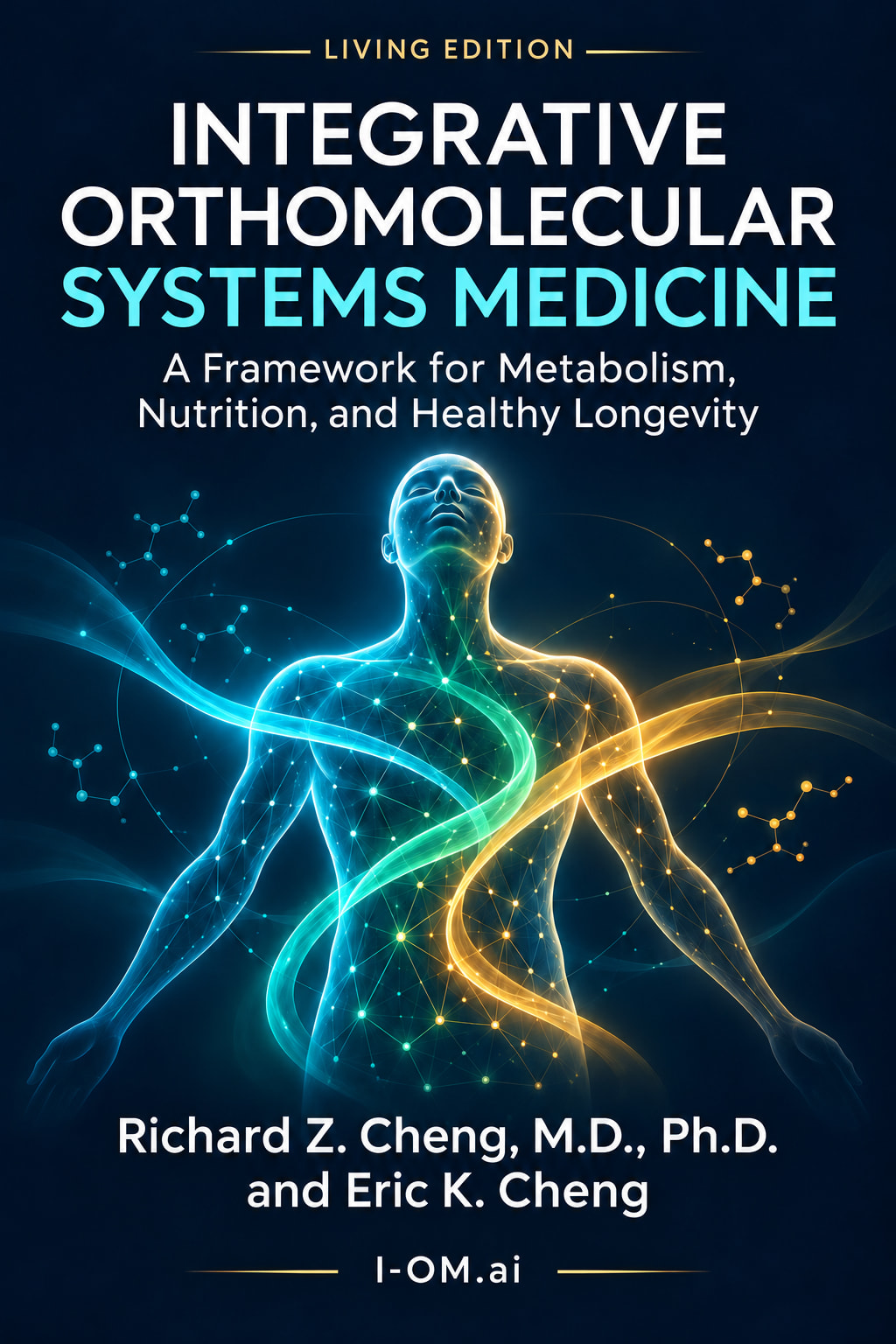
Richard Z. Cheng, M.D., Ph.D., and Eric K. Cheng
A book in development about systems-based medical reasoning, modifiable biology, evidence, and clinical judgment.
About this book
A diagnosis can be accurate and useful while leaving other important questions unanswered. Why did this pattern develop in this person? Which factors may be sustaining it? How do nutrition, metabolism, environment, treatment, and daily life interact over time? What would meaningful improvement look like in function, well-being, and everyday life?
Integrative Orthomolecular Systems Medicine introduces the I-OM framework for organizing these questions. It connects clinical presentation with possible upstream drivers, biological processes, functional capacities, intervention priorities, and monitored outcomes. Appropriate conventional diagnosis and treatment remain central to that approach.
This first volume develops the framework and the reasoning behind it. Its focus is understanding relationships and making responsible distinctions. Detailed nutrient-by-nutrient prescribing is outside this volume’s scope.
Why read it?
The book is designed to help readers:
- Distinguish symptoms, diagnoses, mechanisms, possible drivers, and biomarkers
- Explore how fuel, energy, and repair capacities can organize questions about function and recovery
- Understand the place of nutrition and metabolic strategy within broader clinical care
- Evaluate intervention priorities through safety, effectiveness, and accessibility
- Separate established evidence from emerging findings, mechanisms, clinical experience, and interpretation
- Follow change over time while recognizing uncertainty, treatment burden, and unintended effects
Who is it for?
Clinicians, health professionals, and students seeking an introduction to the I-OM framework; researchers interested in systems-oriented approaches to chronic disease; and scientifically engaged readers who want to understand the questions behind an integrative medical assessment.
Some chapters use technical concepts. Readers new to the subject can begin with Chapters 1–3 and return to the specialized frameworks as needed.
Authors
Richard Z. Cheng, M.D., Ph.D., and Eric K. Cheng.
This volume introduces the public I-OM framework through a connected sequence of concepts, evidence questions, safety considerations, and applications.
Contents
The current book structure contains 18 chapters in six parts. This contents list describes the book’s scope; it does not indicate that every chapter is released for public reading.
Part I
- The Need for a More Complete Medical Model
- What Is Integrative Orthomolecular Systems Medicine?
- From Symptoms to Systems: The I-OM Map
Part II
4. Upstream Drivers of Chronic Disease
5. Downstream Biological Processes
6. The Three Capacities: Fuel, Energy, and Repair
7. The ICV Framework
8. Barrier Dysfunction and Systemic Leaky Barrier Syndrome
Part III
9. Orthomolecular Optimization
10. Metabolic Strategy and Nutrient-Dense Low-Carbohydrate Approaches
11. Biomarkers, Monitoring, and Iterative Care
12. TPIM: Prioritizing Interventions by Safety, Effectiveness, and Accessibility
Part IV
13. Rethinking Evidence Hierarchies
14. Safety, Uncertainty, and Clinical Judgment
Part V
15. Cancer as a Systems Application
16. Healthy Aging: From Chronic Disease Burden to Physiological Reserve
17. Applying I-OM Across Chronic Disease
Part VI
18. The Living I-OM Knowledge Ecosystem
How to read the book
Begin with Chapters 1–3 to understand the framework and its boundaries. Chapters 4–8 develop the systems concepts. Chapters 9–12 address nutrition, monitoring, and intervention priorities; Chapters 13–14 examine evidence and safety. The final chapters apply the framework and explain the living-edition approach.
Throughout, ask what kind of evidence supports each claim, which population or situation it concerns, and whether the proposed application goes beyond what the evidence establishes.
Evidence and medical responsibility
The book distinguishes established evidence, emerging clinical evidence, mechanistic evidence, clinical experience, and I-OM interpretation or hypothesis. These categories carry different levels of confidence. Biological plausibility alone does not establish a treatment benefit, and association does not establish causation.
I-OM’s conceptual maps are aids to reasoning. They are not validated diagnostic algorithms or substitutes for examination, diagnosis, and individualized clinical judgment. This book does not provide personal medical advice or promise that chronic disease can be reversed.
Development and living-edition status
This book is in development. Evidence and reference work, scientific and safety review, editing, and final author approval are part of its preparation. The released text may change as this work progresses.
The living-edition model allows approved revisions to be documented as evidence and understanding develop. Reader feedback can inform editorial review; it does not automatically change the book’s content.
Reading and access
This page introduces the book and its current scope. Available chapters, reading permissions, release arrangements, and any charges will be stated in verified access information. The contents list is not a promise of immediate full-book access.